
Platycryptus californicus
(G.W. Peckham & E.G. Peckham, 1888)
California Flattened Jumping Spider
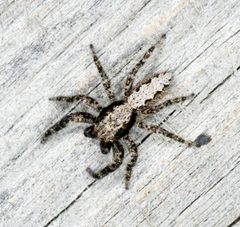
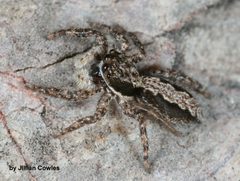
Platycryptus californicus is a jumping spider in the Salticidae native to North and Central America. The is characterized by its dorsoventrally flattened body, an that allows it to hide in narrow crevices. It is closely related to and frequently confused with Platycryptus undatus (the Tan Jumping Spider), though the two species have different geographic ranges. Platycryptus californicus is primarily found in western North America, extending from Canada through the western United States and into Mexico.

Pronunciation
How to pronounce Platycryptus californicus: //ˌplæ.tiˈkrɪp.təs ˌkæl.ɪˈfɔːr.nɪ.kəs//
These audio files are automatically generated. While they are not always 100% accurate, they are a good starting point.
Identification
Platycryptus californicus is most reliably distinguished from the similar Platycryptus undatus (Tan Jumping Spider) by geographic range—P. californicus occurs primarily in western North America while P. undatus is found across eastern North America and extends into southern Canada. The two overlap in Texas. P. californicus may also be confused with Menemerus bivittatus (Gray Wall Jumper), an introduced species in the southern United States, but M. bivittatus shows more pronounced with males having a dark with light bands and females having a light abdomen with dark bands. Examination of genitalia is required for definitive species identification.
Images
Habitat
Found in a variety of terrestrial including woodlands, grasslands, and human-modified environments. Frequently encountered on vertical surfaces such as tree trunks, fence posts, and building walls. The flattened body is an for hiding in bark crevices, under loose bark, and in similar narrow spaces.
Distribution
Native to North America and Central America. Documented from Canada (southern regions), the United States (primarily western states), and Mexico. GBIF records indicate presence across western North America with extensions into Middle America. The appears to be more common in arid and semi-arid regions of the western United States compared to the eastern portions of its range.
Seasonality
are active during warmer months. Specific varies with latitude and elevation. In temperate portions of its range, activity likely peaks in late spring through summer, with reduced activity or in stages during colder periods.
Behavior
An active hunter that relies on vision to stalk and pounce on prey. Like other salticid spiders, it does not construct webs for prey capture but may use silk for safety lines when jumping and for constructing retreats. The flattened body allows it to exploit narrow unavailable to more robust spiders. When disturbed, individuals typically flee rapidly or freeze against the substrate using their camouflaged coloration.
Ecological Role
A of small arthropods. As a common and widespread jumping spider, it contributes to the control of insect in its . Its flattened allows it to occupy a distinct microhabitat , reducing competition with other spiders.
Human Relevance
Occasionally encountered in and around human structures due to its habit of using vertical surfaces and building walls. Not considered medically significant; bites, if they occur, would be expected to produce only minor local effects similar to other small jumping spiders. The is of interest to arachnologists studying the evolution of flattened body morphologies in spiders.
Similar Taxa
- Platycryptus undatusExtremely similar in appearance and size; primarily distinguished by geographic range (eastern North America vs. western for P. californicus), with overlap in Texas. P. undatus is commonly called the Tan Jumping Spider.
- Menemerus bivittatusSimilar use on vertical walls and comparable size. M. bivittatus is an introduced in the southern U.S. with more pronounced in abdominal patterning and a more tropical distribution.
More Details
Taxonomic Note
The Platycryptus was established to accommodate flattened jumping spiders previously placed in other genera. The specific epithet 'californicus' reflects the California type locality, though the has a much broader distribution than the name suggests.
Research Needs
Detailed studies of the ' natural history, including precise geographic boundaries with P. undatus, reproductive , and , appear to be limited in the published literature.
Sources and further reading
- BugGuide
- Wikipedia
- GBIF taxonomy match
- iNaturalist taxon
- NCBI Taxonomy
- Catalogue of Life
- Bohart Museum: Learn about California's State Insect on UC Davis Picnic Day | Bug Squad
- Encyrtid Holdings | Entomology Research Museum
- California Has No State Bee--Yet! | Bug Squad
- Grasshoppers of Colorado
- Sex Attraction Pheromone Improves Detection of a Threatened Beetle
- Bug Eric: Spider Sunday: Gray Wall Jumper