
Marpissa sulcosa
Barnes, 1958
Pike Slender Jumper
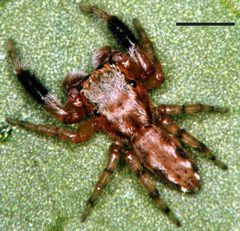
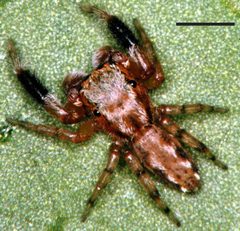
Marpissa sulcosa, commonly known as the Pike Slender Jumper, is a small jumping spider in the Salticidae. It is notable for its extremely elongated body and disproportionately long first pair of legs, which are used primarily for prey capture rather than locomotion. The inhabits grassland environments and employs camouflage and ambush tactics to hunt. It ranges across much of North America, with records from the eastern United States through the Great Plains and into the Southwest.
Pronunciation
How to pronounce Marpissa sulcosa: /mɑːˈpɪsə sʌlˈkoʊsə/
These audio files are automatically generated. While they are not always 100% accurate, they are a good starting point.
Identification
The Pike Slender Jumper is distinguished by its extremely slender, elongate body and remarkably long first pair of legs, which are approximately equal to or exceeding the entire body length. Mature females measure 6.5–9.5 mm in body length; males are slightly smaller at 6–8.2 mm. The heavy, front legs are held extended forward and are not used for —the spider employs its remaining six legs for mobility. Body shape, pattern, and posture provide effective camouflage in grassy .
Images
Habitat
Found in grassland , particularly in arid including beach grasses, dunes, and prairies. Also occurs in riparian areas with tall grasses and herbs. One documented observation involved specimens collected from horsetails (Equisetum sp.) in a dry field setting not immediately adjacent to water.
Distribution
Eastern United States and southeast Canada, westward to Nebraska, Arizona, Colorado, and Texas. Records indicate presence in Pennsylvania and Florida.
Seasonality
Mature individuals occur from spring through fall; in Florida, they have been observed during winter months.
Diet
Active that feeds on insects. Waits in ambush in tall grass for prey to come within striking distance, then uses elongated front legs to seize prey.
Behavior
Highly alert and agile. Does not use front legs for ; relies on six legs for locomotion. Males perform in which they raise the front legs vertically and elevate the to attract females. Capable of jumping, though the elongated front legs are not the appendages used to launch jumps.
Ecological Role
in grassland and prairie , contributing to insect .
Human Relevance
Occasionally encountered during insect-collecting activities and educational events. One documented case involved inadvertent transport of a specimen from Colorado to Texas via a plant, though the is native to both regions. Generally harmless to humans.
Similar Taxa
- Marpissa pikeiThe "Pike Slender Jumper" and descriptive details in available sources appear to apply to Marpissa pikei, suggesting potential confusion or synonymy with M. sulcosa; the relationship between these names requires taxonomic verification.
- Thomisidae (crab spiders)General body form with enlarged front legs may cause superficial resemblance, but crab spiders have laterally flattened bodies, move sideways, and lack the Salticidae arrangement and jumping ability.
- Other SalticidaeMost jumping spiders have stockier bodies with legs more proportional to body size; the extreme elongation of body and first leg pair in M. sulcosa is distinctive.