
Marpissa pikei
(G.W. Peckham & E.G. Peckham, 1888)
Pike Slender Jumper, Long-bodied Jumping Spider
Marpissa pikei is a distinctive jumping spider of the Salticidae, characterized by an extremely elongated, slender body form adapted for in grassy . It is native to North America, ranging from the eastern United States through the Southwest and into Mexico and Cuba. The exhibits striking in coloration, with males displaying bold black and orange patterning while females are more cryptically colored. Its reflects both its discoverer and its notably attenuated body shape.
Pronunciation
How to pronounce Marpissa pikei: //mɑrˈpɪsə ˈpaɪkaɪ//
These audio files are automatically generated. While they are not always 100% accurate, they are a good starting point.
Identification
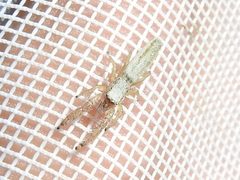
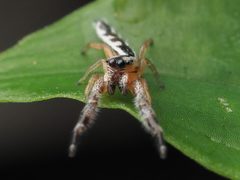
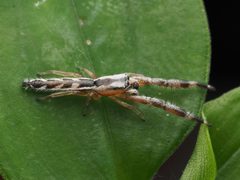
The combination of extreme body elongation, greatly enlarged first pair of legs held extended anteriorly, and resting posture with legs I and II extended forward and legs III and IV extended posteriorly is diagnostic. Males are readily identified by the bold black stripe and orange coloration of legs I and . The may be confused with other slender salticids, but the specific leg proportions and resting posture distinguish it. When disturbed, movement is exceptionally quick and jerky.
Images
Habitat
Associated with grasses, particularly low grasses and tall grasslands. Frequently encountered in beach grasses, dunes, prairies, and other arid grassland . Often found in riparian areas with horsetails (Equisetum) amid dry grasses. Readily collected by sweeping vegetation.
Distribution
Eastern United States west to Nebraska, Colorado, Arizona, and New Mexico; Mexico; Cuba. Records indicate presence in Texas, Oklahoma, Kansas, and Colorado. The appears more abundant in arid grassland than in mesic .
Seasonality
active from May through October in Kansas; mature individuals present spring through fall; year-round activity reported in Florida including winter months.
Diet
Predatory; feeds on insects captured by ambush. Prey is seized using the enlarged first pair of legs.
Life Cycle
Mature present from spring through fall; as adults in southern portions of range (Florida). Specific details of sac construction, development, and lifespan not documented in available sources.
Behavior
Rests with first two pairs of legs extended anteriorly and remaining two pairs extended posteriorly, a posture that enhances when aligned along twigs or grass blades. Movement is rapid and jerky when disturbed. Males perform approaching females with front legs extended and waving; during display, males raise legs vertically and elevate the . The enlarged first pair of legs is used to seize prey but not for locomotion or jumping.
Ecological Role
in grassland and riparian ; contributes to insect through ambush .
Human Relevance
Subject of entomological interest due to distinctive ; occasionally encountered during insect collecting events and educational activities; no documented economic or medical significance.
Similar Taxa
- Other Marpissa speciesShare elongated body form and enlarged legs, but M. pikei is distinguished by specific proportions, coloration, and documented range
- Lyssomanes and other slender salticidsSimilar elongation but differ in arrangement, leg proportions, and resting posture
More Details
Taxonomic History
Originally described as Hyctia pikei by Peckham & Peckham in 1888; subsequently transferred to Marpissa.
Etymology
Specific epithet honors an individual (surname Pike); reflect both this dedication and the ' notably slender body form.
Collecting Notes
Particularly susceptible to collection by sweeping tall grasses, especially in coastal and arid grassland where it may be more abundant than in other .