
Hentzia mitrata
(Hentz, 1846)
White-jawed Jumping Spider
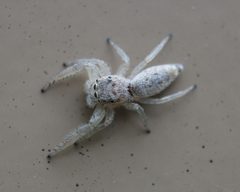
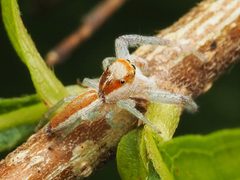
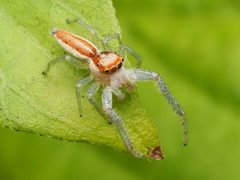
Hentzia mitrata, commonly known as the white-jawed jumping spider, is a small jumping spider in the Salticidae. The species was first described by Nicholas Marcellus Hentz in 1846 and has undergone several taxonomic revisions, with multiple synonyms now synonymized under the current name. It is widely distributed across eastern North America, from southeastern Canada through the eastern United States to Nebraska, with additional records from the Bahamas. The species exhibits in size, with females slightly larger than males, and displays distinctive coloration patterns on the and .
Pronunciation
How to pronounce Hentzia mitrata: //ˈhɛnziə maɪˈtreɪtə//
These audio files are automatically generated. While they are not always 100% accurate, they are a good starting point.
Identification
The can be distinguished from similar Hentzia species by the distinctive coloration pattern on the , which gives the species its 'mitrata' (Latin for 'wearing a mitre' or 'capped'). The combination of the flattened, reddish brown cephalothorax with yellowish white lateral areas and the specific abdominal pattern of spots and stripes is diagnostic. Males are readily identified by the enlarged, white-fringed first legs and the distinctive structure with the twisted tube. The epigyne structure in females provides definitive identification. The species may be confused with other small jumping spiders in the Hentzia, but the specific coloration patterns and genitalic structures allow reliable separation.
Images
Appearance
Small jumping spider with females measuring approximately 5.0 mm and males approximately 4.5 mm in body length. The opisthosoma () is reddish brown dorsally with three pairs of brown spots, with alternating yellowish and reddish narrow stripes laterally. Ventrally, four narrow light-colored broken stripes are surrounded by light reddish areas. The is longer than wide and somewhat flattened, with reddish brown coloration extending through the ocular region to the margin; lateral sides and are yellowish white. Males possess a leg formula of 1423, with the first pair of legs much the longest and fringed with many white hairs. The are distinctive, with the patella about equal in length to the tibia, and the much broader anteriorly than at the base, featuring a conspicuous twisted tube structure. The are vertical and of moderate size, with the fang groove containing two slender promarginal teeth and a single retromarginal tooth.
Habitat
Found in a variety of across its range, including residential areas where it has been observed on porch railings and vegetation. Specific microhabitat preferences are not well documented, but like many jumping spiders, it likely occupies vegetation, structures, and other surfaces where it can hunt actively.
Distribution
Widely distributed across eastern North America, ranging from southeastern Canada (including Quebec and Ontario) through much of the eastern United States, extending westward to Nebraska. Also recorded from the Bahamas. The distribution encompasses diverse regions from the Atlantic coast to the Great Plains.
Seasonality
have been observed from spring through fall, with specific seasonal patterns not well documented. One observation record indicates presence in late May.
Behavior
Active hunter typical of jumping spiders, using vision to stalk and pounce on prey. Males possess enlarged front legs that likely serve a function in , though specific courtship for this has not been detailed in the available literature. The species has been observed on vegetation and man-made structures.
Ecological Role
of small arthropods, contributing to regulation of insect in its .
Human Relevance
Occasionally encountered in residential settings, such as on porch railings and vegetation around homes. Not considered a pest; like most jumping spiders, it is harmless to humans and may provide some benefit as a of small insects.
Similar Taxa
- Hentzia palmarumAnother small Hentzia with similar general appearance, but H. palmarum males have even more dramatically enlarged and darkened front legs used in courtship, and the species has different coloration patterns and genitalic structures.
- Other small Salticidae generaSmall jumping spiders in such as Phidippus or Zygoballus may be superficially similar in size and active hunting , but differ in arrangement details, body proportions, and coloration patterns.
More Details
Taxonomic History
The has a complex taxonomic history with multiple synonyms. Hentz originally described the male as Attus mitratus and the female as Attus morigerus in the same 1846 publication, not recognizing them as the same species. Carl Ludwig Koch described Maevia sulphurea and Maevia pallida in 1846, later determined to be synonyms. The species was transferred to the Hentzia by Chickering in 1944.
Etymology
The 'mitrata' is Latin meaning 'wearing a mitre' or 'capped', referring to the distinctive coloration pattern on the .