
Hentzia
Marx, 1883
Long-jawed Jumping Spiders
Species Guides
5- Hentzia alamosa
- Hentzia chekika
- Hentzia grenada
- Hentzia mitrata(White-jawed Jumping Spider)
- Hentzia palmarum(common hentz jumper)
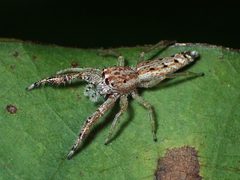
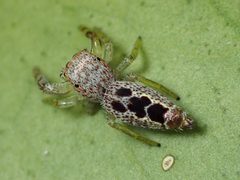
Hentzia is a of jumping spiders (Salticidae) in the Dendryphantinae, established by G. Marx in 1883 and named after arachnologist Nicholas Marcellus Hentz. The genus contains approximately 22 recognized distributed primarily in the Caribbean region, with Cuba hosting the greatest diversity (seven species). North American species include the widespread H. palmarum and H. mitrata, along with western outlier species H. poenitens and H. fimbriata. Males exhibit elaborate involving leg spreading, abdominal cocking, and zigzag approaches toward females.
Pronunciation
How to pronounce Hentzia: /ˈhɛn.tsi.a/
These audio files are automatically generated. While they are not always 100% accurate, they are a good starting point.
Identification
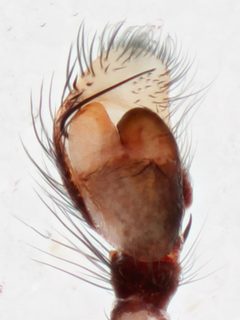
Females are distinguished by the presence of hair (setal) pencils below the medial and spatulate hairs on the margin of the first patella and —characters absent in the related Anicius. Males possess enlarged, often darkened front legs that function in courtship signaling. Both sexes show differences in palpal and epigynal structure compared to Anicius, though the two genera share close anatomical affinities.
Images
Habitat
Hentzia palmarum is associated with palms and vegetation in sand prairie , as suggested by its epithet and field observations. Caribbean species occupy varied tropical and subtropical environments across island .
Distribution
Widespread in North America and northern South America, with primary biodiversity center in the Caribbean. Cuba contains seven . North American distribution includes eastern and central United States, southeastern Canada, Bermuda, and the Bahama Islands, with outlier species in western North America (H. poenitens, H. fimbriata) ranging from Mexico to Colombia.
Behavior
Males perform elaborate beginning with front leg spreading, cocked 30 degrees above the substrate and angled to one side, and zigzag approaches toward females from distances of 3-4 cm. In H. palmarum, males may switch abdominal orientation during courtship, eventually touching the female with front legs and mounting if receptive. Male-male agonistic displays escalate from similar postures to fang unsheathing, cheliceral locking, and biting. Ritualized fighting occurs without immediate escalation to injury in similarly sized opponents.
Similar Taxa
- AniciusClosely related dendryphantine jumping spiders sharing similar body plan and male palpal structure, but distinguished by absence of female setal pencils below medial and lack of spatulate hairs on first patella and .
More Details
Etymology
named by G. Marx in 1883 to honor Nicholas Marcellus Hentz (1797-1856), an early American arachnologist who described the type H. palmarum (as Epiblemum palmarum) and H. mitrata (as Attus mitratus) in 1846.
Species diversity
As of 2020, 22 recognized; H. elegans considered dubious and likely not belonging to Hentzia. Richman (1989) provided the most recent comprehensive revision of the .
Research significance
H. palmarum served as subject for one of the first Boolean mathematical models of (Crocker & Skinner 1984), quantifying decision rules in courtship and agonistic interactions.