
Maevia
C. L. Koch, 1846
Dimorphic Jumping Spider (M. inclemens)
Species Guides
5- Maevia albozonata
- Maevia b
- Maevia expansa
- Maevia inclemens(Dimorphic Jumping Spider)
- Maevia intermedia
Maevia is a of jumping spiders (Salticidae) historically encompassing from both the New World and Asia. The genus has undergone significant taxonomic revision, with most Asian species transferred to other genera. The best-studied species, M. inclemens, exhibits remarkable male dimorphism with two distinct morphs differing in appearance and courtship .

Pronunciation
How to pronounce Maevia: /ˈmeɪ.vi.a/
These audio files are automatically generated. While they are not always 100% accurate, they are a good starting point.
Identification
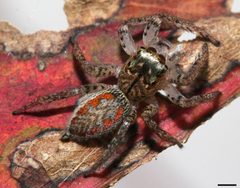
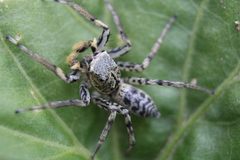
Males of M. inclemens occur in two distinct forms: the 'tufted form' is all-black with white legs and a triple tuft of setae on the ; the 'gray form' has black pinstripes with orange spots and chevrons. Females are consistently pale with orange or red longitudinal stripes on the . Body length ranges 4.8–7.0 mm (males) and 6.5–10 mm (females). Other in the lack documented diagnostic features.
Images
Habitat
in this occupy understory vegetation, walls, fences, and human structures. M. inclemens is frequently found in wooded areas, on building exteriors, and occasionally enters homes.
Distribution
New World occur in the United States, Canada, and Peru. Asian species are recorded from Sumatra, though several lack recent documentation.
Diet
M. inclemens feeds primarily on insects and has been observed consuming nectar from extrafloral of Prunus shrubs. Diet of other is undocumented.
Behavior
M. inclemens males perform complex visual that differ between morphs: tufted-form males stand elevated with dipped, waving front legs overhead; gray-form males adopt a low posture and sidle. Females possess distinct recognition templates for each morph's display. Both morphs produce signals that result in nearly identical visual target area to females at different distances.
Ecological Role
As jumping spiders, they function as visual in understory and building-associated . Occasional nectar consumption may contribute to pollination dynamics.
Human Relevance
M. inclemens is among the most commonly encountered jumping spiders in the eastern United States. Its distinctive male dimorphism makes it a subject of behavioral research and public interest. Occasionally enters homes but poses no threat.
Similar Taxa
- Other SalticidaeMale dimorphism in M. inclemens is unique among jumping spiders; other lack this specific combination of discrete morphological and behavioral alternatives.
Sources and further reading
- BugGuide
- Wikipedia
- GBIF taxonomy match
- iNaturalist taxon
- NCBI Taxonomy
- Catalogue of Life
- Bug Eric: Dimorphic Jumping Spider, Maevia inclemens
- Maevia-inclemens - Entomology Today
- Maevia inclemens Archives - Entomology Today
- Bug Eric: One Night, One House, Seventeen Spider Species
- Spiders Enjoy Vegetarian Meals Occasionally
- Signal efficacy and the evolution of male dimorphism in the jumping spider, Maevia inclemens.