
Maevia inclemens
(Walckenaer, 1837)
Dimorphic Jumping Spider
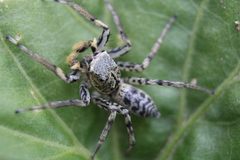
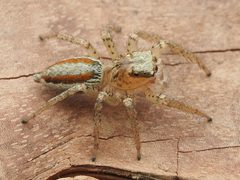
Maevia inclemens is a small jumping spider native to eastern North America, notable for its extreme male dimorphism. males occur in two genetically determined morphs of equal frequency: a 'tufted' morph with an all-black body, white legs, and three cephalothoracic tufts, and a 'gray' morph with black-and-white striping and orange . Each morph performs a distinct , and both achieve equal mating success. The frequents vegetation, fences, and building exteriors.

Pronunciation
How to pronounce Maevia inclemens: /ˈmɑːviə ɪnˈklɛmɛns/
These audio files are automatically generated. While they are not always 100% accurate, they are a good starting point.
Identification
Males are immediately identifiable by their two distinct morphs, a phenomenon rare among spiders. The tufted morph resembles no other common North American salticid; the gray morph might be confused with other striped salticids but is distinguished by its orange and specific courtship . Females may be confused with other pale, striped salticids but lack the abdominal patterning of Phidippus or Habronattus and show the characteristic white sub-ocular stripe. The combination of (eastern North American understory and structures), size, and arrangement confirms identification.
Images
Appearance
Females are 6.5–8.0 mm in body length with a light brown , pale unmarked legs, and a chalky to rusty bearing black lateral bands and sometimes orange . A prominent white stripe lies below the . Males are smaller (4.75–6.50 mm) with two distinct morphs. The 'tufted' morph has an entirely black body and , white legs, and three conspicuous black tufts of bristles across the . The 'gray' morph has black and white stripes on body and legs, bright orange pedipalps, a white stripe on the foremost eyes, and no tufts. Both sexes have a rectangular, moderately high carapace and the large anterior median eyes characteristic of Salticidae.
Habitat
Found in deciduous forest understory, shrubby vegetation, and edge . Frequently occupies man-made structures including outbuildings, fences, walls, and building exteriors; less common inside permanently inhabited houses. Occurs from ground level to several meters above ground on vegetation and vertical surfaces.
Distribution
Eastern and mid-western United States and south-eastern Canada. Documented from Massachusetts, Connecticut, New York, New Jersey, Pennsylvania, Maryland, West Virginia, Virginia, North Carolina, Florida, Alabama, Louisiana, Texas, Kansas, Kentucky, Indiana, Illinois, Michigan, Wisconsin, Quebec, Ontario, and Manitoba.
Seasonality
Active primarily during warmer months; observed from spring through fall. Specific varies by latitude within its range.
Diet
Primarily insectivorous, capturing small prey through active pursuit and jumping. Has been observed drinking nectar from extrafloral of Prunus shrubs, representing facultative plant feeding.
Life Cycle
laid in silk retreats. Spiderlings undergo multiple , with progressive development of coloration. Males reach sexual maturity and adopt one of two genetically determined morphs (tufted or gray) based on father's morph, not environmental conditions. Both morphs occur at approximately 50% frequency in .
Behavior
visual hunter that does not build capture webs. Males perform elaborate : tufted morph stands elevated on legs, claps legs, waves , and sways from ~9 cm distance; gray morph crouches low, extends anterior legs forward in triangular configuration, holds orange pedipalps beneath , and glides in semi-circles from ~3 cm distance. Both morphs transition to leg-clapping and zig-zag dancing as females approach. Females respond similarly to both morphs but show more initial attention to gray morphs at close range and to tufted morphs at longer distances. Post-copulation, pairs typically separate; males sometimes attempt additional copulations. Regular observed, using fangs and pedipalps to clean legs and body.
Ecological Role
of small arthropods in forest understory and anthropogenic . Occasional nectar feeding may contribute to nutrient intake during prey scarcity. Serves as prey for larger spiders, birds, and other vertebrates. Male dimorphism represents a maintained potentially stabilized by frequency-dependent selection.
Human Relevance
Generally considered beneficial due to on small pests. Occasionally enters buildings but not a persistent household pest. Subject of extensive behavioral research on , signal evolution, and the maintenance of genetic . Frequently photographed and observed by naturalists due to its approachable nature and striking male morphs.
Similar Taxa
- Phidippus audaxBold jumping spider overlaps in range and ; distinguished by larger size, iridescent , and lack of male dimorphism or tufted morph
- Habronattus spp.Some have ornamented males with similar size; distinguished by different and leg ornamentation, and lack of the specific tufted/gray dimorphism
- Evarcha spp.Similar size and use; distinguished by different abdominal patterning and male courtship lacking the dimorphic displays of Maevia
More Details
Male dimorphism maintenance
The two male morphs represent a rare example of discrete, genetically determined in spiders. Each morph is equally successful in mating, with tufted males more effective at long-range female attraction and gray males more effective at close-range courtship. This represents a potential mixed evolutionarily stable strategy maintained by frequency-dependent selection.
Vision and signal evolution
Research using computer-animated males demonstrates that females possess two distinct recognition templates for the different morphs. Despite divergent displays, both morphs present females with images of nearly identical height and visual target area at critical courtship distances, suggesting selection for signal efficacy across different environmental contexts.
Historical taxonomy
The two male morphs were originally described as separate due to their dramatic differences in appearance and . Robert Barnes established M. inclemens as the valid name in 1955. The species name derives from Latin 'inclēmens' meaning 'cruel, harsh, or rough'.
Sources and further reading
- BugGuide
- Wikipedia
- GBIF taxonomy match
- iNaturalist taxon
- NCBI Taxonomy
- Catalogue of Life
- Bug Eric: Dimorphic Jumping Spider, Maevia inclemens
- Bug Eric: One Night, One House, Seventeen Spider Species
- Spiders Enjoy Vegetarian Meals Occasionally
- Maevia inclemens Archives - Entomology Today
- Maevia-inclemens - Entomology Today
- Signal efficacy and the evolution of male dimorphism in the jumping spider, Maevia inclemens.