
Maevia expansa
Barnes, 1955
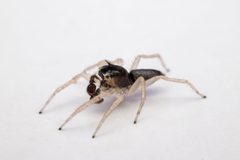
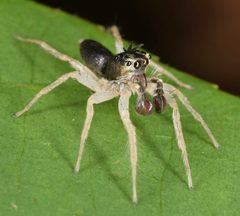
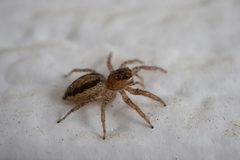
Maevia expansa is a of jumping spider in the Salticidae, described by Barnes in 1955. It belongs to a notable for pronounced male dimorphism, though specific details for M. expansa remain poorly documented. The species occurs in the United States, with records from North America. Information regarding its , , and distinguishing characteristics is sparse compared to the well-studied Maevia inclemens.
Pronunciation
How to pronounce Maevia expansa: /ˈmaɪ.vi.ə ɛkˈspæn.sə/
These audio files are automatically generated. While they are not always 100% accurate, they are a good starting point.
Identification
No specific diagnostic features for Maevia expansa are documented in available sources. The Maevia can be recognized by the presence of male dimorphism in at least one (M. inclemens), but whether M. expansa shares this trait has not been established. Identification to species level likely requires examination of genitalic by a .
Images
Distribution
United States; North America. Specific locality records beyond country-level are not available in the provided sources.
Similar Taxa
- Maevia inclemensCongeneric jumping spider with well-documented male dimorphism (tufted and gray forms), similar size range, and overlapping geographic distribution in the eastern United States. M. inclemens is the most commonly encountered and studied in the , making it the most likely source of confusion.
More Details
Taxonomic note
Maevia expansa was described by Barnes in 1955, but has received minimal subsequent study. The Maevia currently contains few , with M. inclemens being the most thoroughly documented due to extensive research on its male dimorphism and courtship . The relationship between M. expansa and M. inclemens, including whether M. expansa exhibits similar male , remains uninvestigated.
Data limitations
Available sources provide only taxonomic placement and geographic occurrence for this . The extensive behavioral and ecological documentation available for M. inclemens in the provided sources should not be extrapolated to M. expansa without direct evidence.