
Hasarius adansoni
(Audouin, 1826)
Adanson's house jumper
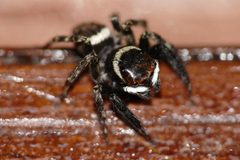
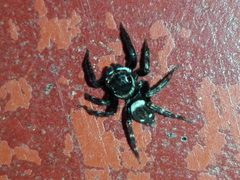
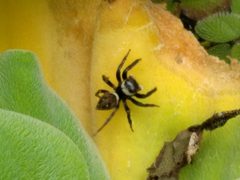
Hasarius adansoni is a small jumping spider (Salticidae) with pronounced . Females reach 8 mm, males 6 mm. Males display distinctive black coloration with a red facial 'mask', white , and iridescent white markings on the . The is strongly associated with human structures across tropical and subtropical regions worldwide, and has been introduced to temperate areas via greenhouses. It constructs silk retreats at night, approximately twice its body length.
Pronunciation
How to pronounce Hasarius adansoni: /həˈsɛəriəs əˈdænsənaɪ/
These audio files are automatically generated. While they are not always 100% accurate, they are a good starting point.
Identification
Males are readily identified by the combination of black body, red facial mask, and white with iridescent sheen. The paired white crescents on the ( and ) and small posterior dots provide additional confirmation. Females are less distinctive, appearing as small dark brown jumping spiders with -tinged abdomens; identification requires careful examination and may need expert verification. The ' association with human structures in tropical regions aids field recognition.
Images
Habitat
Strongly associated with human-modified environments including buildings, walls, and greenhouses. Native to warm regions; introduced occur in heated indoor environments in temperate zones. Constructs silken retreats in sheltered locations.
Distribution
Pantropical and subtropical distribution with widespread introduction. Native or established in: Malta, India, Japan, Brazil, Taiwan, Tanzania, Australia, Algeria, Laos, Vietnam, China (Gansu, Guangxi, Guangdong, Yunnan provinces), Galápagos Islands, Pacific Islands, Africa, Middle East. Introduced to Europe (greenhouses, zoos), North America, and South America.
Diet
Active ; specific prey records not documented in sources.
Life Cycle
Females lay in silk retreats. Egg-laying influenced by mating history. Developmental stages follow typical salticid pattern (egg, post-embryo, spiderling, , ) but specific duration details not documented.
Behavior
retreat construction: builds silk shelter approximately twice body length, sometimes reusing the same retreat but often constructing additional nearby shelters. Males have been observed feeding on females, though this may be accidental rather than predatory. Pre-copulatory occur; copulation involves extended mate contact. Post-copulatory include retreat construction for -laying.
Ecological Role
in anthropogenic environments; specific contributions not documented.
Human Relevance
Common inhabitant of human dwellings in tropical and subtropical regions; frequently encountered on walls and structures. Introduced to temperate regions via greenhouses and zoos. No documented economic or medical significance.
Similar Taxa
- Other Hasarius speciesWithin same ; require examination of male genitalia and specific color pattern details for separation
- Other small black-and-white jumping spiders (Salticidae)Males' distinctive red mask and iridescent help distinguish H. adansoni; many similar lack the red facial marking or have different abdominal patterns
More Details
Taxonomic history
Originally described as Attus adansonii by Audouin in 1826. Redescribed 86 times in recognized literature by 2012, often placed in different . First assigned to Hasarius by Eugène Simon in 1871. Named after French naturalist Michel Adanson.