
Habronattus ophrys
Griswold, 1987
Habronattus ophrys is a of jumping spider in the Salticidae, first described by Griswold in 1987. The species is known from the United States. Like other members of the Habronattus, it is a small, ground-dwelling spider with acute vision characteristic of salticids. Males of the genus typically display elaborate courtship involving visual and vibratory signals.


Pronunciation
How to pronounce Habronattus ophrys: /hæbroʊˈnætəs ˈoʊfrɪs/
These audio files are automatically generated. While they are not always 100% accurate, they are a good starting point.
Identification
The combination of black body with orange middle section distinguishes this from many other jumping spiders. Definitive identification to species level in Habronattus requires examination of male or female under magnification. Similar species include other Habronattus with black and orange color patterns; microscopic examination of genitalia is necessary for confirmation.
Images
Appearance
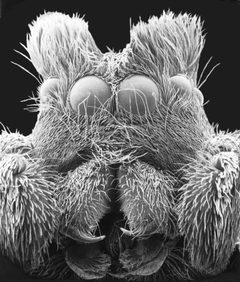
Black body with orange coloration on the middle section (). As with other Habronattus , likely small in size (most species in this range from 3-7 millimeters in body length). The genus is characterized by compact, robust bodies typical of jumping spiders, with large that provide excellent vision.
Habitat
Ground-dwelling, found in areas of scattered vegetation where it prowls on stones or amid leaf litter. Typical Habronattus includes prairies, grasslands, and open areas with sparse ground cover.
Distribution
United States. Records indicate presence in North America, specifically within the USA. The Habronattus shows highest diversity in the southwestern United States.
Behavior
As a member of the Habronattus, likely exhibits complex multimodal courtship involving both visual displays and vibratory signals (drumming/tapping). Males of the genus characteristically use modified third legs in , bending them to maximize visibility of knee joints to females. Hunting behavior typical of salticids: active pursuit of prey using keen eyesight rather than web-building.
Ecological Role
of small insects and other arthropods. As a jumping spider, contributes to regulation of insect in ground-level .
Similar Taxa
- Other Habronattus speciesMany in this share similar size, body plan, and color patterns; microscopic examination of genitalia required for definitive separation
- Phidippus apacheanusAlso a black and orange jumping spider, but larger (5-13 mm) with different body proportions and found on vegetation rather than ground
- Euophrys monadnockMale has black and orange coloration but with distinctive white-tipped legs and different geographic distribution
More Details
Taxonomic note
described by Griswold in 1987. The Habronattus contains approximately 100 species, most occurring in North America with highest diversity in the southwestern United States.
Genus characteristics
Habronattus jumping spiders are noted for having among the most elaborate of any terrestrial , combining visual signals through leg movements with complex vibratory drumming patterns.
Sources and further reading
- BugGuide
- Wikipedia
- GBIF taxonomy match
- iNaturalist taxon
- NCBI Taxonomy
- Catalogue of Life
- Bug Eric: What a Spider!
- Bug Eric: September 2012
- Bug Eric: A Case of Predator Mimicry in the Bee Fly Genus Epacmus? (Diptera: Bombyliidae)
- Tenthredinidae | Beetles In The Bush
- Plant hunting in South Essex - Buglife Blog - Buglife