
Habronattus bulbipes
(Chamberlin & Ivie, 1941)
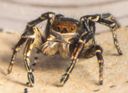
Habronattus bulbipes is a of jumping spider ( Salticidae) first described by Chamberlin and Ivie in 1941. The Habronattus comprises approximately 100 species, most occurring in North America, with the greatest diversity in the southwestern United States. Members of this genus are small, ground-dwelling spiders known for elaborate multimodal combining visual and acoustic signals.
Pronunciation
How to pronounce Habronattus bulbipes: /hæbroʊˈnætəs ˈbʌlbɪpiːz/
These audio files are automatically generated. While they are not always 100% accurate, they are a good starting point.
Images
Habitat
Ground-dwelling in areas of scattered vegetation, including prairie and areas with stones or leaf litter.
Distribution
United States; North America. Records indicate presence in prairie in Colorado Springs, Colorado, and other locations within the ' range.
Behavior
Males of the Habronattus perform complex combining visual signals with substrate-borne acoustic signals. Males drum or tap to create vibrations synchronized with visual displays. Many in the genus have modified third legs used in visual recognition by females, often featuring conspicuous spurs or bright coloration.
Similar Taxa
- Other Habronattus speciesWithin the , are distinguished by specific leg modifications, color patterns, and courtship . H. bulbipes specifically has bulbous or swollen on the first leg pair, referenced in its species epithet.
- Euophrys monadnockBoth are small, colorful, ground-dwelling jumping spiders found in similar in Colorado. Euophrys monadnock males have bright orange on the third and fourth legs and black front legs with dense hair brushes, whereas Habronattus typically display modified third legs in courtship.
More Details
Taxonomic note
The specific epithet 'bulbipes' refers to the swollen or bulbous on the first leg pair, a diagnostic character for this .
Genus characteristics
Habronattus is one of the most -rich of jumping spiders in North America, with species ranging from above the Arctic Circle to coastal Canada, throughout the United States, and into the neotropics. The genus is particularly diverse in the southwestern U.S. and Florida.