
Psilochorus simoni
(Berland, 1911)
Wine Cellar Spider
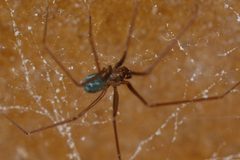
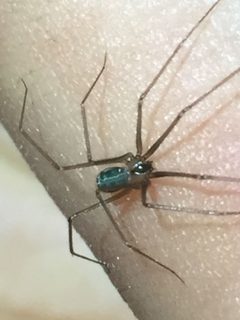
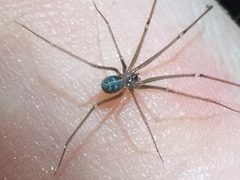
Psilochorus simoni is a cellar spider in the Pholcidae, native to subtropical America and introduced to Europe, Turkey, New Zealand, and Australia. The is commonly known as the "Wine Cellar Spider" due to its historical association with wine cellars, though it has become established in garden centres and greenhouses. It constructs dome-shaped webs and has been recorded from cave environments in Europe, including Slovenia's Postonjska jama, where it shows morphological adaptations to subterranean life.
Pronunciation
How to pronounce Psilochorus simoni: //ˌsaɪloʊˈkɔːrəs sɪˈmoʊnaɪ//
These audio files are automatically generated. While they are not always 100% accurate, they are a good starting point.
Images
Habitat
environments including wine cellars, garden centres, and greenhouses; also recorded from cave environments in Europe at temperatures of 2–4°C and 95–100% relative humidity. Found on cave walls and in crevices.
Distribution
Native to subtropical America (United States); introduced and established in Europe, Turkey, New Zealand, and Australia. Recorded from caves in France, Spain, Morocco, and Slovenia (Postonjska jama).
Life Cycle
and juveniles observed co-occurring in cave environments, indicating established breeding . Specific developmental stages and duration not documented.
Behavior
Constructs dome-shaped, tidy webs. Adopts typical pholcid posture with legs extended in a cone-like shape. Shows morphological adaptations to cave life including elongated appendages.
Human Relevance
"Wine Cellar Spider" reflects historical association with human structures; now frequently encountered in commercial plant nurseries and greenhouses. that has spread globally through human commerce.
More Details
Cave Adaptation
Specimens in Postonjska jama cave display morphological traits associated with subterranean life, including elongated appendages. The may be troglophilic (cave-dwelling but not obligate) or potentially troglobiotic (obligate cave-dweller), though this requires further study.
Taxonomic History
Originally described as Physocyclus simoni by Berland in 1911, later transferred to Psilochorus. The Psilochorus is characterized by distinctive genital and copulatory mechanisms that have been subject of detailed anatomical study.
Sources and further reading
- BugGuide
- Wikipedia
- GBIF taxonomy match
- iNaturalist taxon
- NCBI Taxonomy
- Catalogue of Life
- Psilochorus hooki Slowik ventral | Entomology Research Museum
- Primary Type List | Entomology Research Museum
- Publications | Entomology Research Museum
- Psilochorus simoni (Berland, 1911) (Araneae: Pholcidae), a new record for slovenian spider fauna from Postonjska jama cave Psilochorus simoni (Berland, 1911) (Araneae: Pholcidae), nova najdba za favno Slovenije iz Postojnske jame
- Genital Morphology, Copulatory Mechanism and Reproductive Biology in Psilochorus Simoni (Berland, 1911) (Pholcidae; Araneae)