
Philodromus praelustris
Keyserling, 1880
Resplendent Running Crab Spider
Philodromus praelustris is a running crab spider in the Philodromidae, found in the United States and Canada. It has an and is known to occur in orchard in Ontario. Females are capable of producing multiple sacs, with laboratory observations recording up to 12 sacs containing over 200 eggs total, though in natural settings appears lower. The disperses primarily by bridging—casting air-borne web loops that catch on distant objects—rather than by ballooning.
Pronunciation
How to pronounce Philodromus praelustris: //ˌfɪloʊˈdroʊməs preɪˈlʌstrɪs//
These audio files are automatically generated. While they are not always 100% accurate, they are a good starting point.
Identification
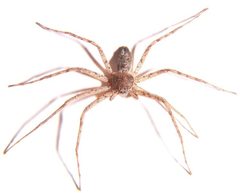
As a member of the Philodromidae , this exhibits the characteristic laterigrade leg orientation typical of running crab spiders, with legs positioned for sideways movement. Specific diagnostic features distinguishing it from would require examination of genitalia or other subtle morphological characters not readily visible in field observations.
Images
Habitat
Orchards in the Niagara Peninsula of Ontario, Canada. The has been documented in this specific agricultural , though its broader habitat preferences across its North American range remain insufficiently documented.
Distribution
United States and Canada. Specific records include the Niagara Peninsula of Ontario, Canada, and Alberta, Canada. The full extent of its range within North America is not comprehensively mapped.
Diet
Prey is perceived by contact or very short-distance vision. Two were experimentally rejected as prey, though the specific ant species were not identified in available sources.
Life Cycle
. Females produce sacs sequentially, with up to 12 sacs and over 200 eggs total recorded in insectary conditions. Later eggs in the sequence often fail to hatch. in natural orchard is considerably lower than in laboratory settings.
Behavior
Disperses primarily by bridging—casting air-borne loops of silk that catch on distant objects and allowing the spider to traverse gaps. No experimental evidence supports ballooning as a mechanism, though very young individuals may occasionally balloon. Prey capture relies on contact or extremely short-range visual detection rather than active pursuit or web-based trapping.
Ecological Role
in orchard . Its specific impact on pest or broader ecological function has not been quantified.
Human Relevance
Documented presence in agricultural orchards suggests potential role in dynamics within managed landscapes. No specific economic impact or pest control value has been established.
Similar Taxa
- Philodromus cespiticolisSympatric congeneric in Ontario with which it shares orchard and ; distinguished by subtle morphological differences requiring close examination.
- Selenops species (Selenopidae)Both are flattened spiders with laterigrade legs that can be confused by casual observers; Selenops has six in one row and increasingly longer legs from front to back, while Philodromus has eight eyes and the second pair of legs longest.
Sources and further reading
- BugGuide
- Wikipedia
- GBIF taxonomy match
- iNaturalist taxon
- NCBI Taxonomy
- Catalogue of Life
- Bug Eric: Shower Spiders
- Bug Eric: July 2013
- Bug Eric: Spider Sunday: Flatties
- Bug Eric: October 2014
- Bug Eric: Return of "Arachtober!"
- LIFE HISTORIES AND HABITS OF TWO SPECIES OF PHILODROMUS (ARANEIDA: THOMISIDAE) IN ONTARIO