
Tapinesthis
Simon, 1914
Ivy parchment spider
Species Guides
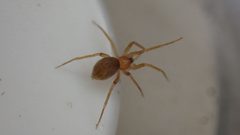
1Tapinesthis is a of goblin spiders ( Oonopidae) containing only Tapinesthis inermis, commonly known as the ivy parchment spider. The genus is characterized by its spineless legs, steeply sloping with a dark net-like pattern, and soft body structure. Originally native to Europe, the has been introduced to North America and shows tendencies, frequently inhabiting human dwellings alongside natural . The genus name reflects its distinctive morphological features within the diverse goblin spider family.
Pronunciation
How to pronounce Tapinesthis: //ˌtæpɪˈnɛsθɪs//
These audio files are automatically generated. While they are not always 100% accurate, they are a good starting point.
Identification
Distinguished from other Oonopidae by the combination of completely spineless legs, steeply sloping with net-like pattern, and soft body lacking a . The absence of spines separates it from many goblin spiders; the net-like petiolus structure resembles Orchestina but arrangement differs. The single-structured tarsal claws and specific trichobothrial hood structure with rib-like elements are diagnostic. Males and females differ in gland numbers: males have 2 piriform glands on anterolateral spinnerets versus 3 in females, and fewer aciniform glands on spinnerets.
Images
Appearance
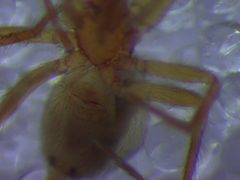
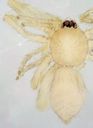
Small, pale goblin spiders with soft bodies. Females reach 2.4–2.5 mm body length, males 1.8 mm. The is steeply sloping with a dark net-like pattern and pale border; in living specimens it appears pale yellowish-orange to pink, turning yellowish-white to pale orange when preserved. The legs are entirely spineless (the source of the epithet 'inermis,' meaning 'unarmed'), white, and lack patterns. The opisthosoma is -shaped, soft, yellowish-brown, and patternless, lacking a . Six arranged in two rows (four upper, two lower), all well-developed but unequal in size. The petiolus has a net-like structure. Tarsal claws are single-structured, arranged in a comb-like row with six teeth on the lateral surface of upper claws.
Habitat
Inhabits forests, dry grasslands, and garrigue. Strongly , commonly found in human dwellings. In southern Europe, tends toward natural environments outside settlements; in Central Europe, occur year-round in buildings.
Distribution
Native to Europe with expanding range; confirmed in Germany, Netherlands, Belgium, Czech Republic, Austria, Switzerland, France, Italy, Spain, and Bulgaria. Introduced to North America (United States and Canada).
Seasonality
Mature active March–May and July–October. In Central European buildings, adults likely present year-round. Previously hypothesized seasonal forms (spring and summer) have been refuted; observed variation results from age-related darkening rather than true seasonality.
Behavior
poorly studied. shows bimodal activity in spring and late summer to autumn. facilitates year-round presence in heated buildings. Age-related darkening occurs, possibly due to pigment uptake from prey.
Human Relevance
frequently found in human dwellings. No documented negative impacts; presence in buildings is benign. Considered very rare in Germany with insufficient data for conservation assessment; categorized as Ecologically Sustainable in Czech Republic due to environmental adaptability.
Similar Taxa
- OrchestinaShares net-like petiolus structure, but differs in arrangement (Tapinesthis has intermediate, near H-shaped pattern versus tightly clustered in Orchestininae) and tarsal organ receptor pattern
- Other OonopidaeMost have spines on legs and/or on opisthosoma, both absent in Tapinesthis; many have different slope and pattern
Misconceptions
The hypothesis of two seasonal forms (spring and summer) with distinct coloration and setation, proposed by Dalmas in 1916, has been refuted. Research since 2014 demonstrates that observed differences result from age-related changes—older spiders darken and lose setae—rather than true seasonal dimorphism.
More Details
Taxonomic History
Originally described as Oonops inermis by Simon in 1882; transferred to the new Tapinesthis by Simon in 1914. The genus has remained .
Subfamily Placement
classification remains unresolved. arrangement, conductor structure, and tarsal organ patterns show intermediate characteristics between Oonopinae and Orchestininae, requiring further research.
Genital Morphology
Male have pear-shaped bulb with long, medially curved, tubular embolus with grooved pale tip. Female epigyne features distinctive T-shaped and square anterior spermatheca with glandular ducts confined to part—unlike other Oonopidae where ducts occur at middle or base.