
Orchestina
Simon, 1882
goblin spiders
Species Guides
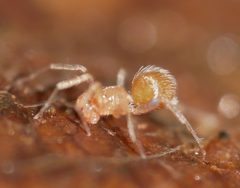
1Orchestina is a -rich of tiny goblin spiders ( Oonopidae) containing over 180 extant species. Members measure 1.0–3.0 mm in body length and possess an enlarged fourth enabling jumping. The genus exhibits a nearly global distribution in the Northern Hemisphere south of 45°N, with highest diversity in Central and South America, Africa, and Asia. First described by Eugène Simon in 1882.
Pronunciation
How to pronounce Orchestina: /ɔɹˈkɛstɪnə/
These audio files are automatically generated. While they are not always 100% accurate, they are a good starting point.
Identification
Distinguished from other Oonopidae by the enlarged fourth adapted for jumping. -level identification relies on male palpal (tibia enlargement, sperm duct loop configuration, embolus shape) and female endogyne structures ( receptaculum shape, lateral protrusions, epigaster markings). Some species exhibit distinctive net-shaped patterns. is common; males of some species have clypeal protrusions.
Images
Habitat
Primarily forest , where they represent a spider group as evidenced by extensive collections through canopy fogging. Also found under bark, in leaf litter, grasses, suspended litter, and occasionally inside buildings. In China, occurs in tropical seasonal rainforest, monsoon forest, and limestone monsoon rainforest at elevations from 707 m to 3062 m. Some collected via pitfall trapping in high-elevation forests (2600 m).
Distribution
Nearly global distribution in the Northern Hemisphere south of 45°N. Highest diversity and abundance in Central to South America, Africa, and Asia. Present in North America, Europe, and Australia with fewer . In China, recorded from Yunnan Province (Xishuangbanna, Cangshan Mountain, Dali City), Xizang/Tibet Autonomous Region (Linzhi City, Motuo Co., Pome Co., Nang Co.), Hainan, and Jiangxi. China harbors more than 20 species, with Xishuangbanna, Yunnan containing at least eight species. Northernmost Chinese species is Orchestina zhiwui.
Behavior
Capable of jumping due to enlarged fourth . Considered a group in forest based on collection data.
Ecological Role
group of spiders in forest .
Human Relevance
Occasionally found inside buildings. Subject of taxonomic research due to high .
Similar Taxa
- Other Oonopidae generaOrchestina is distinguished from other goblin spiders by the enlarged fourth adapted for jumping; most other Oonopidae lack this modification.
More Details
Taxonomic history
First described by Eugène Simon in 1882. As of October 2025, the contains more than 180 , making it one of the most speciose genera in Oonopidae. Recent taxonomic work in China has described numerous new species from Yunnan and Xizang.
Collection methods
Most -dwelling specimens collected through canopy fogging. Ground-dwelling and litter-dwelling collected via sifting forest leaf litter, pitfall trapping, beating bushes, and ground searching.
Sources and further reading
- BugGuide
- Wikipedia
- GBIF taxonomy match
- iNaturalist taxon
- NCBI Taxonomy
- Catalogue of Life
- A survey of Orchestina Simon, 1882 (Araneae, Oonopidae) from Xishuangbanna, China, with descriptions of eight new species.
- Three new species of Orchestina Simon, 1882 (Araneae, Oonopidae) from Xizang, China.
- Two new species of Orchestina Simon, 1882 (Araneae, Oonopidae) from Cangshan Mountain, Yunnan, China.