
Gladicosa pulchra
(Keyserling, 1877)
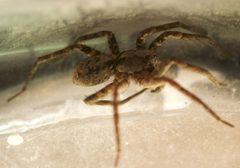
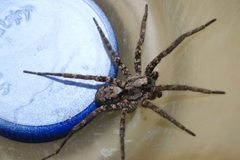
Gladicosa pulchra is a of wolf spider in the Lycosidae. It occurs in the eastern and central United States, where it has been documented on tree trunks, under logs, and in rocky areas. Laboratory studies have demonstrated that this species is capable of predating upon small vertebrates, including spotted salamanders and ground skinks, indicating complex ecological relationships beyond typical prey.
Pronunciation
How to pronounce Gladicosa pulchra: /ɡlædɪˈkoʊsə ˈpʌlkrə/
These audio files are automatically generated. While they are not always 100% accurate, they are a good starting point.
Images
Habitat
Found on tree trunks, under logs, and under rocks. Associated with forested environments including mesic upland forests dominated by oaks and hickories, and drier forest types near bluffs.
Distribution
United States; specifically documented in the mid-Atlantic, southeastern, and south-central regions. Records include Missouri, New Jersey, and other eastern states.
Seasonality
Observed active in winter conditions; one record documents surface activity with temperatures in the mid-20s°F (approximately -4°C).
Diet
. Laboratory experiments demonstrate on spotted salamanders (Ambystoma maculatum) and ground skinks (Scincella lateralis). Prey capture involves inserting into the vertebrate prey. Also likely preys on typical of lycosid spiders.
Behavior
Exhibits predatory toward small vertebrates, including multiple attack sequences per encounter. Attacks may be complete ( inserted) or incomplete (chelicerae not inserted). Prey movement increases attack frequency. Does not overtly respond to chemical stimuli from skink prey.
Ecological Role
with demonstrated capacity for -vertebrate . Potential role in regulating of small terrestrial vertebrates including salamanders and lizards. Engages in intraguild predation with ground skinks, which share and food resources.
Similar Taxa
- Gladicosa gulosa in same ; both are wolf spiders in Gladicosa. G. gulosa is a known for spider wasps (Anoplius aethiops, Priocnemis minorata), whereas G. pulchra has been documented as a of vertebrates.
More Details
Vertebrate predation behavior
Laboratory studies show G. pulchra attacks vertebrate prey differently than typical prey. Salamanders respond to complete attacks by flipping onto their backs, a previously undescribed in this salamander group. Skinks employ antipredatory immobility when exposed to spider stimuli, suggesting recognition of spiders as prior to encounter.
Structural refugia effects
In -prey experiments with ground skinks, the presence of structural refugia significantly increased the time required for spiders to successfully prey upon skinks, indicating complexity mediates this interaction.
Sources and further reading
- BugGuide
- Wikipedia
- GBIF taxonomy match
- iNaturalist taxon
- NCBI Taxonomy
- Catalogue of Life
- Bug Eric: Priocnemis minorata
- North America’s most beautiful tiger beetle | Beetles In The Bush
- Bug Eric: Wasp Wednesday: Anoplius aethiops
- Rockwoods Reservation, Lime Kiln Loop Trail | Beetles In The Bush
- An experimental assessment of invertebrate/vertebrate predation: the interaction between wolf spiders (Gladicosa pulchra) and terrestrial salamanders (Ambystoma maculatum)
- The potential for invertebratevertebrate intraguild predation: the predatory relationship between wolf spiders (Gladicosa pulchra) and ground skinks (Scincella lateralis)