
Neriene radiata
(Walckenaer, 1841)
Filmy Dome Spider
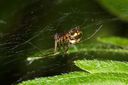
Neriene radiata, commonly known as the filmy dome spider, is a sheet-weaving spider in the Linyphiidae with a Holarctic distribution spanning North America, Europe, and Asia. It constructs a distinctive dome-shaped web of fine silk, hanging upside-down beneath it to capture prey. The is notable for its delicate web architecture and has been frequently observed in natural history studies.


Pronunciation
How to pronounce Neriene radiata: /ˈne.ri.e.ne ra.diˈa.ta/
These audio files are automatically generated. While they are not always 100% accurate, they are a good starting point.
Identification
Identified by its distinctive dome-shaped sheet web, constructed of extremely fine silk that appears filmy or gauze-like. The spider hangs inverted beneath the dome, a characteristic of this . As an entelegyne spider, females possess complex genitalia () and males have correspondingly modified , which are essential for species-level identification. specimens cannot be reliably identified to species.
Images
Distribution
Holarctic distribution: North America, Europe (including Germany, Spain), Turkey, Caucasus, Russia (European part to Far East), Kazakhstan, China, Korea, and Japan.
Behavior
Constructs a dome of fine silk and hangs upside-down beneath it, waiting for prey to contact the web. As with other entelegyne spiders, males wander to find mates and use modified as intromittent organs, transferring sperm via a sperm web.
Similar Taxa
- Neriene sp.Other dome spiders in the same share the characteristic dome web architecture and hanging ; -level identification requires examination of genitalia
Sources and further reading
- BugGuide
- GBIF taxonomy match
- iNaturalist taxon
- NCBI Taxonomy
- Catalogue of Life
- Wasps Used to Combat Citrus Greening Disease are Unlikely to Threaten Non-target Insects
- Bug Eric: Spider Sunday: Spider Sex Ed
- Biological Control in Brazil is Used on an Area that is Larger than Belgium
- Heliconiidae | Beetles In The Bush