
Microlinyphia pusilla
(Sundevall, 1830)
Platform spider
Microlinyphia pusilla is a small sheet-web spider in the Linyphiidae, characterized by strong and a distinctive hammock-shaped web built close to the ground in vegetation. Males actively wander in search of mates during autumn, while females and males remain on their webs. The has a Holarctic distribution across North America and Eurasia.
Pronunciation
How to pronounce Microlinyphia pusilla: /mɪˌkrɒlɪnˈɪfiə pjuːˈsɪlə/
These audio files are automatically generated. While they are not always 100% accurate, they are a good starting point.
Identification
Distinguished from other Microlinyphia by the male's circular embolus filament visible on the . The leaf-shaped black mark on the female's silvery is diagnostic. The small hammock-shaped web built close to the ground amid grasses and low vegetation separates it from orb-weaving spiders and other sheet-web builders that construct webs at higher positions or with different architectures.
Images
Appearance
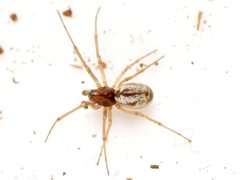
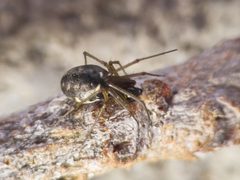
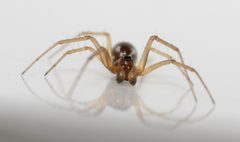
Males are black and shiny with a narrow , approximately 5 mm in body length excluding legs. Females are slightly larger with a much plumper, silvery abdomen bearing a distinctive leaf-shaped black mark. Males possess a circular filament called the embolus issuing from the , a hair-like structure serving as the sperm channel during mating.
Habitat
Constructs webs in vegetation near the ground, typically among grasses and low plants. Webs are built in open or semi-open where low vegetation provides support for the sheet structure.
Distribution
Holarctic distribution spanning North America and Eurasia. Recorded from Albania, Britain, France, and Germany in Europe; present across northern North America including Colorado and New Mexico in the western United States.
Seasonality
active into late autumn; males wander in search of mates during fall. Activity extends into November in favorable conditions. sacs produced after mating, with eggs and spiderlings within silk insulation.
Life Cycle
Females produce one or more sacs after mating. Eggs hatch within the protective silk package, with spiderlings remaining inside until weather becomes favorable for . occurs as eggs or spiderlings within the egg sac.
Behavior
Males actively wander in search of mates during autumn, leaving their webs to find females. Females and males remain on their flat, sheet-like webs, clinging upside down to the underside. The exhibits ballooning for , with individuals climbing vertical objects to catch wind and disperse to new .
Ecological Role
of small insects and other arthropods captured in sheet webs. Serves as prey for larger arthropods and small vertebrates. Contributes to insect in grassland and open vegetation .
Human Relevance
Generally harmless to humans. Occasionally encountered in outdoor restrooms or buildings near natural . Benefits humans by preying on pest insects.
Similar Taxa
- Metepeira spp.Also builds sheet-like web elements, but constructs a combination orb web and tangled snare rather than a simple hammock-shaped sheet; produces sacs in tubular retreats rather than on the open web.
- Linyphia spp.Formerly classified together; M. pusilla distinguished by embolus structure and specific abdominal markings in females.