
Florinda
O. Pickard-Cambridge, 1896
Scarlet Sheetweb Weaver, Black-tailed Red Sheetweaver, Red Grass Spider
Species Guides
1- Florinda coccinea(Black-tailed Red Sheetweaver)
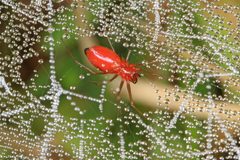
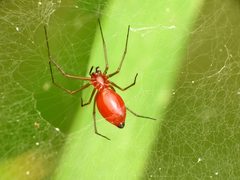
Florinda is a of dwarf spiders in the Linyphiidae, containing only Florinda coccinea. This small spider is notable for its bright scarlet coloration with distinctive black markings, including a diagnostic black on the rear of the . The genus was established by Octavius Pickard-Cambridge in 1896.
Pronunciation
How to pronounce Florinda: /flɔˈrɪndə/
These audio files are automatically generated. While they are not always 100% accurate, they are a good starting point.
Identification
Florinda coccinea is distinguished from other similarly colored spiders by the presence of a black on the . Males measure 3-3.5 mm in body length and are generally more conspicuous than females due to their wandering in search of mates. The spider's bright red coloration with black accents is distinctive among North American linyphiids.
Images
Habitat
Grasslands, lawns, and agricultural fields. The fine silk of their sheet webs makes them nearly invisible unless coated with dew droplets.
Distribution
Southeastern United States, ranging north to Maryland and southern New Jersey, and west to Missouri and eastern Kansas. Also recorded from Mexico and the West Indies. The may be expanding its range northward and westward.
Seasonality
Active during spring and fall; observations suggest the possibility of multiple per year, with both sexes found in webs in October.
Behavior
Males are shockingly agile for a adapted to life in a silken snare, dropping suddenly into foliage when disturbed. The spider has been observed feigning death when threatened, becoming motionless and unresponsive. Web-shaking has not been documented for this .
Similar Taxa
- CeraticelusBoth are small, brightly colored red spiders in the Linyphiidae; Florinda is distinguished by the black abdominal and sheet-web building versus the dwarf spider habits of Ceraticelus.
- HypsosingaBoth can appear as small, red orb-weaving spiders; Florinda builds sheet webs rather than orb webs and possesses the diagnostic black absent in Hypsosinga.