
Ceraticelus
Simon, 1884
dwarf spiders
Species Guides
9- Ceraticelus artemisiae
- Ceraticelus atriceps
- Ceraticelus bulbosus(dwarf spider)
- Ceraticelus crassiceps(Thick-headed Dwarf Weaver)
- Ceraticelus emertoni
- Ceraticelus fissiceps(dwarf spider)
- Ceraticelus laetabilis
- Ceraticelus minutus(dwarf spider)
- Ceraticelus similis(dwarf spider)
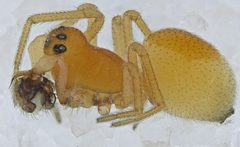
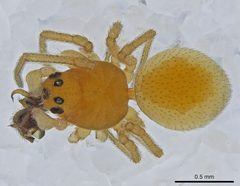
Ceraticelus is a of dwarf spiders in the Linyphiidae, Erigoninae. First described by Eugène Louis Simon in 1884, the genus currently contains approximately 34 and two distributed primarily in North America, with some species occurring in Europe and Asia. The genus definition has been historically problematic due to superficial treatment of male palpal bulb . Recent taxonomic work has clarified diagnostic characters through examination of the type species, C. fissiceps.
Pronunciation
How to pronounce Ceraticelus: /ˌsɛrəˈtɪsələs/
These audio files are automatically generated. While they are not always 100% accurate, they are a good starting point.
Identification
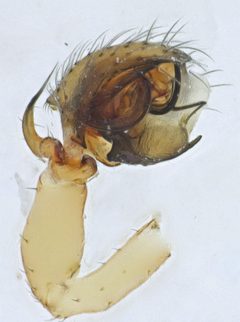
Identification relies on detailed examination of male genitalia, particularly the conformation of the palpal bulb and paracymbium . The has been difficult to define due to inadequate historical descriptions of these structures. -level identification requires comparison with and attention to subtle differences in bulb shape and paracymbium configuration. Some species exhibit distinctive coloration, including bright red individuals that have been observed on flowering vegetation.
Images
Habitat
Coastal sage scrub and oak woodlands in southern California. Other occupy varied terrestrial across North America including prairies, forests, and riparian areas.
Distribution
Primarily North American, with the majority of restricted to the United States. C. bulbosus has a broad distribution spanning North America, the Netherlands, Germany, Poland, Finland, and Russia (Europe to Far East). C. orientalis occurs in Russia. C. nigripes and C. tumidus are found in Cuba. C. paludigena occurs in the USA and Hispaniola.
Human Relevance
C. phylax in southern California may represent an introduced through human activity rather than natural . The is of interest to arachnologists studying linyphiid and .
Similar Taxa
- FlorindaBoth are small, brightly colored spiders in Linyphiidae that can occur on flowering vegetation; Florinda is in Linyphiinae (sheetweb spiders) while Ceraticelus is in Erigoninae (dwarf spiders), requiring genitalic examination for definitive separation.
- HypsosingaSmall brightly colored spiders that can be mistaken for Ceraticelus; however, Hypsosinga is in Araneidae (orb-weavers) and constructs orb webs rather than the sheet webs or ground-dwelling habits of linyphiids.