
Hypsosinga
Ausserer, 1871
Species Guides
3- Hypsosinga funebris(Meadow Dark-eyed Orbweaver)
- Hypsosinga pygmaea(spotted false pajama spider)
- Hypsosinga rubens(Rubens Orbweaver)
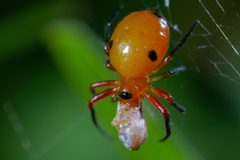
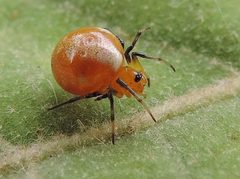
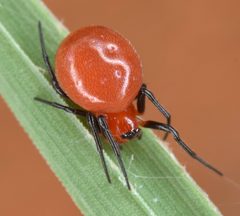
Hypsosinga is a of small orb-weaver spiders in the Araneidae, first described by Anton Ausserer in 1871. The genus name derives from Greek "hypso" meaning "high," referring to the higher compared to the related genus Singa. are characterized by shiny bodies with spots or lines and construct small, often overlooked orb-webs in low vegetation. The genus contains nineteen species and three as of October 2025, with a wide distribution across Eurasia, Africa, and North America.
Pronunciation
How to pronounce Hypsosinga: /hɪp.soʊˈsɪŋ.ɡə/
These audio files are automatically generated. While they are not always 100% accurate, they are a good starting point.
Identification
Distinguished from the closely related Singa by having as the largest (rather than median eyes in Singa), and by the oval widest in the middle (Singa has a different abdominal shape). The ocular quadrangle is wider behind than in front or rectangular. The epigyne lacks a scape, unlike both Singa and Araneus. Confusion with theridiids (especially Steatoda) is possible for living under stones.
Images
Habitat
Low vegetation where small orb-webs frequently go unnoticed. Some live under stones. Found in grasslands (frequently sampled in sweep nets), forest edges, and disturbed forests. One species (H. ryani) recorded from elevations of 250-440 m in disturbed forest; another (H. zioni) from 80-1060 m in disturbed forest and acacia plantations.
Distribution
Wide global distribution. Most occur in Eurasia from Greenland to Japan. Few species in Africa and North America. Specific records include: Israel, Vietnam (Vinh Phuc, Ninh Binh, Hai Phong provinces), England (Dorset, Cambridgeshire), and eastern North America with scattered records from Canadian Prairie Provinces.
Behavior
Constructs complete orb-webs, usually with a retreat. Web-building occurs in low vegetation where webs are easily overlooked. Some exhibit defensive web-shaking when disturbed. One species has been observed to remain in the hub of the web when approached rather than dropping out.
Ecological Role
in grassland and forest edge . Prey capture via orb-webs contributes to insect in these .
Human Relevance
Subject of taxonomic research and citizen science documentation. H. heri in the UK is of conservation interest, with only three recorded sightings between 1898 and 2015.
Similar Taxa
- SingaClosely related with similar shiny appearance; differs in arrangement ( eyes largest in Singa vs. median eyes in Hypsosinga), abdominal shape, and epigyne structure.
- Steatoda living under stones can be confused with these theridiids; distinguished by web architecture and morphological features.
- AraneusShares Araneidae; distinguished by epigyne lacking scape in Hypsosinga.
More Details
Etymology
The name derives from Greek "hypso" meaning "high," referring to the higher than in the genus Singa.
Taxonomic history
New synonyms have been defined including Singa affinis and Singa attica = Hypsosinga albovittata. The has been subject to revision in the Mediterranean region and Middle East.
Sources and further reading
- BugGuide
- Wikipedia
- GBIF taxonomy match
- iNaturalist taxon
- NCBI Taxonomy
- Catalogue of Life
- Araneae | Beetles In The Bush | Page 4
- In search of a little brown lacewing - Buglife Blog - Buglife
- Bug Eric: Wh-a-a-a-t? Another Red Spider?!
- The Spider Genera Singa and Hypsosinga (Araneae, Araneidae) in Israel
- On five new species of the genera Araneus and Hypsosinga (Araneae, Araneidae) from Vietnam.