
Florinda coccinea
(Hentz, 1850)
Black-tailed Red Sheetweaver, Scarlet Sheetweb Weaver, Red Grass Spider
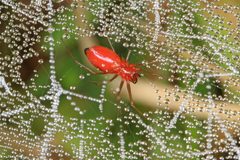
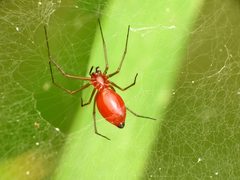
Florinda coccinea is a small, vividly colored sheetweb-weaving spider in the Linyphiidae. It is the sole in its . The spider is notable for its bright red body with black accents, particularly a distinctive black on the rear of the . Despite its striking coloration, it is rarely observed due to its minute size (3-3.5 mm body length) and the near-invisibility of its fine silk webs. The species occurs in grasslands, lawns, and agricultural fields across the southeastern United States, with records extending north to New England and west to Kansas, plus Mexico and the West Indies.
Pronunciation
How to pronounce Florinda coccinea: //flɔːˈrɪndə kɒkˈsaɪniə//
These audio files are automatically generated. While they are not always 100% accurate, they are a good starting point.
Identification
The black on the rear of the is diagnostic for this and distinguishes it from other similarly colored red spiders. The combination of small size (3-3.5 mm), bright red coloration with black accents, and sheetweb-building in grassy further supports identification. When disturbed, individuals may feign death (), appearing limp and unresponsive.
Images
Appearance
Small spider with bright red coloration and black accents. Males and females both exhibit the red base color, but males are generally more conspicuous as they travel to seek mates. The most distinctive feature is a black (prominent bump) on the of the , a trait not found in similarly colored spiders. The silk of its webs is extremely fine and nearly invisible unless coated with dew or water droplets.
Habitat
Grasslands, lawns, agricultural fields, and other grassy areas. Webs are constructed low in vegetation, typically in grass or other ground-level plants.
Distribution
Southeastern United States, ranging north to at least Maryland, southern New Jersey, and Vermont; west to Missouri, eastern Kansas, and Iowa; also recorded in Mexico and the West Indies. The may be expanding its range northward and westward, though detection is limited by its inconspicuous nature.
Seasonality
have been observed in both spring (May) and fall (October), suggesting the possibility of multiple per year, though this remains uncertain.
Life Cycle
are presumably laid within the fine sheet webs, though detailed documentation is sparse. The observation of both sexes in webs during October suggests potential for more than one annually.
Behavior
Males actively wander in search of females, making them more frequently encountered than sedentary females. When threatened, individuals exhibit (feigning death), becoming limp and unresponsive. The is remarkably agile for a spider that typically resides in a stationary web.
Ecological Role
A small in grassland and lawn , likely consuming minute arthropods captured in its sheet webs. The webs may contribute to regulation of of tiny insects in grassy .
Human Relevance
Occasionally noted in yards, gardens, and agricultural settings. Its bright coloration makes it a subject of interest for arachnologists and naturalists, though its small size and cryptic webs prevent most human encounters. Not known to be of economic significance.
Similar Taxa
- Other red-colored spiders (various families)Florinda coccinea is distinguished by the unique black abdominal , which is absent in other similarly colored . Sheetweb architecture and (low grassy vegetation) also help separate it from orb-weavers and other web-building spiders.