
Erigone atra
Blackwall, 1833
Post Dwarf Weaver
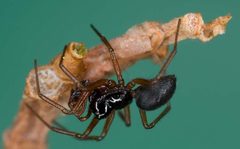
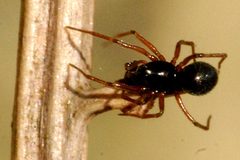
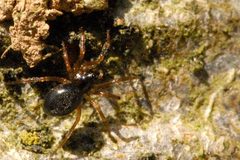
Erigone atra is a small sheet-weaving spider in the Linyphiidae, commonly known as the Post Dwarf Weaver. It is one of the most abundant in its , with a holarctic distribution spanning North America, Europe, and Asia. The species is notable for its extensive use of aerial via ballooning, which enables of agricultural including cereal fields and grasslands. E. atra is recognized as an important agent in agroecosystems, where it preys on crop pests such as aphids.
Pronunciation
How to pronounce Erigone atra: //ˈɛrɪɡoʊni ˈa.trə//
These audio files are automatically generated. While they are not always 100% accurate, they are a good starting point.
Identification
Difficult to distinguish from congeneric due to similar size and coloration. Diagnostic features include the 2-2-2-1 tibial spine pattern, specific arrangement, and examination of structure. Females closely resemble Erigone arctica; males closely resemble Erigone dentipalpis. Examination of genitalia may be required for definitive identification.
Images
Habitat
Primarily inhabits grasslands, fallows, and crop fields, particularly cereal fields. Prefers grasslands with high vegetation yield and low . Uses sown weed strips in cereal fields as sites. In winter, occupies higher vegetation for protection and insulation. Found in grazing lands where combined cattle and sheep grazing creates uniform short grass expanses.
Distribution
Holarctic distribution. Most abundant in Western Europe. Recorded from North America, Europe (including Russia from European region to Far East), Central Asia, China, Mongolia, Korea, and Japan.
Seasonality
Two per year. First generation from overwintered produces offspring maturing in early summer. Second generation matures in early fall. Some females overwinter fertilized, storing sperm for spring production. Peak activity in warm periods of early summer and fall.
Diet
Preys primarily on aphids (Aphididae) and springtails. Also consumes gnats and other small crop pests. Prey selection varies by and is size-dependent; females show minor preference for larger springtails and have higher rates than males.
Life Cycle
Development highly temperature-dependent. At 20°C, reaches adulthood in approximately 20 days; at 10°C, development averages 150 days; at 5°C, only once. Two annually with partial overlap. Females produce multiple sacs throughout life, averaging 4.4–11.8 eggs daily at optimal temperatures. Clutch size averages 12–14 eggs, decreasing with female age. Females typically die within 10 days of producing final egg sac. Lifespan sexually dimorphic: females live on average 18 days longer than males. Egg sacs parasitized by Gelis festinans, a specialized ichneumonid .
Behavior
Exhibits extensive aerial via ballooning, initiated by tip-toeing where spiders climb to elevated positions, raise , and release silk threads to catch air and electric currents. Ballooning cues include wind turbulence, food deprivation, and temperature increases, with mass dispersal in late summer triggered by high temperatures. Also performs short-distance rappelling using silk for controlled bridging. Captures prey both by web entanglement and active hunting; males hunt almost exclusively without webs. Builds small sheet webs ( 7.6 cm² in crop fields) over ground depressions or bare soil as bases for ambush hunting.
Ecological Role
Important in agricultural , contributing to of crop pests. Functions as a source in cereal field systems, colonizing crops from grassland refugia. Serves as for specialized Gelis festinans. Its ballooning enables rapid of disturbed and agricultural fields.
Human Relevance
Valued as a agent in agriculture due to on aphids and other crop pests. Its presence in cereal fields and grasslands contributes to . Agricultural practices such as combined grazing and maintenance of grassland strips can enhance .
Similar Taxa
- Erigone arcticaFemales very similar in appearance; requires careful examination for differentiation
- Erigone dentipalpisMales very similar in appearance; structure may be needed for identification
- Lepthyphantes tenuisSympatric linyphiid in agricultural ; silk not recognized by E. atra Gelis festinans, suggesting chemical differences
- Bathyphantes gracilisSympatric linyphiid with similar use; silk not recognized by G. festinans
- Oedothorax retususSympatric in agricultural fields; silk not recognized by G. festinans
- Oedothorax fuscusSympatric ; silk not recognized by G. festinans
More Details
Ballooning physiology
Ballooning involves release of gossamer silk threads that interact with drag from air currents and static electricity fields. Tip-toeing posture maximizes silk release via muscular control. Propensity for ballooning influenced by maternal conditions during offspring rearing, indicating developmental plasticity.
Web characteristics
Webs are small, irregular mesh sheets without ordered patterns typical of orb-weavers. Webs serve primarily as hunting platforms rather than prey entanglement structures; prey capture does not strictly require web presence.
Reproductive plasticity
highest at 20–25°C. Increased prey availability enhances reproductive output; females may kill excess prey beyond immediate consumption when prey is abundant, with prey consumption per increasing with availability.
Sources and further reading
- BugGuide
- Wikipedia
- iNaturalist taxon
- NCBI Taxonomy
- Catalogue of Life
- What a Wasp! What a Tattoo! | Bug Squad
- Bug Eric: Caught on Video: Prionyx atratus
- T.G.I.Flyday—Black horse fly (Tabanus atratus) | Beetles In The Bush
- Three new species of ground snakes discovered under graveyards and churches in Ecuador
- Lymexylidae | Beetles In The Bush
- Multiple Megarhyssa males | Beetles In The Bush
- Environmental and genetic background of tiptoe-initiating behaviour in the dwarfspider Erigone atra
- Observations on the life cycle of Erigone atra (Araneae, Erigoninae) in a heavily grazed pasture
- Sown weed strips in cereal fields: overwintering site and “source” habitat for Oedothorax apicatus (Blackwall) and Erigone atra (Blackwall) (Araneae: Erigonidae)
- Host location by Gelis festinans, an eggsac parasitoid of the linyphiid spider Erigone atra