
Hypochilus kastoni
Platnick, 1987
Hypochilus kastoni is a of lampshade spider in the Hypochilidae, described by Norman Platnick in 1987. It is one of several species in the Hypochilus, a group of spiders notable for their distinctive web architecture and relictual distribution in North America. The species is known from the western United States, where it inhabits rocky . Like other Hypochilus species, it constructs characteristic flat, circular webs with a conical retreat, resembling a lampshade in appearance.
Pronunciation
How to pronounce Hypochilus kastoni: /haɪpoʊˈkaɪləs ˈkæstəni/
These audio files are automatically generated. While they are not always 100% accurate, they are a good starting point.
Identification
Distinguished from congeneric primarily by genitalic , particularly male and female , as described in the original species description. Geographic distribution helps separate it from eastern species such as H. thorelli and H. petrunkevitchi. Externally similar to H. pococki, from which it is distinguished by details of abdominal patterning and precise locality data. Identification to species level requires examination of reproductive structures or genetic analysis.
Images
Appearance
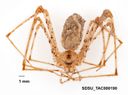
Medium-sized spider with elongated legs and a relatively flattened body. Coloration generally dark with patterning typical of the . The and show mottled or banded patterns that provide camouflage against rock substrates. Legs are long and slender, adapted for web construction on vertical rock . The lacks the extreme elongation of some other Hypochilus species, with body proportions intermediate within the genus.
Habitat
Rocky , specifically cliff , rock outcrops, and boulder fields in mountainous regions. Webs are constructed on vertical or near-vertical rock surfaces, often in shaded or partially shaded locations. The substrate appears to be primarily sandstone or similar sedimentary rock formations. Habitat specificity reflects the ancestral of the Hypochilidae .
Distribution
Known from the western United States, specifically from localities in Utah and possibly adjacent states. Distribution records are sparse, reflecting limited survey effort in appropriate rocky rather than true rarity. The occupies a geographic range intermediate between the more widespread H. pococki to the west and eastern .
Behavior
Constructs the characteristic 'lampshade' web typical of the : a flat, circular sheet web with a central conical retreat opening downward. The spider occupies the retreat, emerging onto the sheet to capture prey. Web architecture represents an evolutionary intermediate between ancestral cribellate webs and more derived araneomorph web types. activity pattern inferred from related , with web maintenance occurring during darkness.
Ecological Role
on small flying and crawling insects in rocky . Its specialized web architecture allows exploitation of vertical rock that are underutilized by other web-building spiders. The contributes to diversity in cliff and talus , habitats often poorly sampled in biodiversity assessments.
Human Relevance
No documented direct interactions with humans. The is of interest to arachnologists studying spider and the evolution of web-building , due to its position as a phylogenetically significant lineage (Hypochilidae represents the sister group to all other Araneomorphae). Potential for intact rocky .
Similar Taxa
- Hypochilus pocockiOverlapping or adjacent geographic distribution in western North America; similar preferences on rock ; distinguished by genitalic and subtle differences in abdominal patterning
- Hypochilus thorelliEastern with similar overall and web architecture; distribution (Appalachian region) is the primary distinguishing feature
- Hypochilus petrunkevitchiEastern with elongated body form; geographic separation and proportional differences in leg length aid distinction
More Details
Taxonomic significance
Hypochilus kastoni was described relatively recently (1987) during Norman Platnick's comprehensive revision of the Hypochilidae. The epithet honors arachnologist Allan P. Kaston. The Hypochilus is the sole genus in Hypochilidae, a of critical importance for understanding spider evolution due to its phylogenetic position as sister to all other Araneomorphae.
Conservation considerations
Like other Hypochilus , H. kastoni may be vulnerable to disturbance specific to rocky cliff , including rock climbing activity, quarrying, and recreational development. However, no formal conservation assessment has been published.