
Neotama mexicana
(O. Pickard-Cambridge, 1893)
Mexican Two-tailed Spider, Long-spinneret Spider
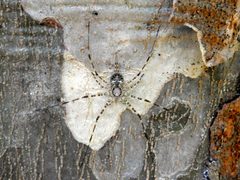
Neotama mexicana is a of tree trunk spider in the Hersiliidae, commonly known as the Mexican two-tailed spider or long- spider. It is distinguished by its elongated spinnerets, which extend conspicuously beyond the . The species has been documented from the southern United States through Central America to northern South America, including Peru and Guyana. It is an arboreal species associated with tree trunks and bark .
Pronunciation
How to pronounce Neotama mexicana: /niˈoʊtəmə ˌmeksɪˈkænə/
These audio files are automatically generated. While they are not always 100% accurate, they are a good starting point.
Identification
Distinguished from other spiders by the extraordinary length of the , which are markedly longer than those of nearly all other spider . Within Hersiliidae, separation from requires examination of genitalic structures and detailed morphological features not summarized in general sources. The flattened body profile and association with tree bark help distinguish it from ground-dwelling spiders.
Images
Appearance
Possesses extremely long, cylindrical that extend well beyond the tip, giving the spider its of "two-tailed spider." The body is typically flattened dorsoventrally, an for living in narrow crevices under bark. Coloration is generally cryptic, matching bark substrates. The spinnerets are much shorter than the posterior pair. Legs are long and slender, adapted for rapid movement on vertical surfaces.
Habitat
Arboreal; associated with tree trunks and bark surfaces. Found in forested and woodland where it occupies crevices under loose bark and in tree trunk fissures.
Distribution
United States (southern regions) south through Mexico and Central America to Peru and Guyana in South America. Specific US state records require verification; documented from Valle del Cauca and Meta in Colombia, and multiple Brazilian states including Acre, Pará, Rondônia, and Roraima.
Behavior
Has been observed occupying crevices under tree bark, where its flattened body allows it to squeeze into narrow spaces. The extremely long are used to wrap silk around prey from a distance while the spider remains concealed in its retreat.
Ecological Role
in arboreal ; likely contributes to control of bark-dwelling insects and other small arthropods.
Human Relevance
No documented medical significance or economic impact. Occasionally encountered by naturalists and arachnologists due to its distinctive appearance.
Similar Taxa
- Other Hersiliidae genera (e.g., Hersilia, Murricia)Share the characteristic of elongated , but differ in body proportions, spinneret length ratios, and geographic distribution. Detailed examination of arrangement and genitalia required for definitive separation.
- Anyphaenidae (buzzing spiders)Some have moderately long and similar flattened bodies, but lack the extreme spinneret elongation diagnostic of Hersiliidae.
More Details
Taxonomic Note
The Neotama was established to accommodate previously placed in other hersiliid genera. The Hersiliidae is a relatively small group of spiders, with most species occurring in tropical and subtropical regions. The elongated are a synapomorphy of the family and represent a distinctive evolutionary for prey capture from concealed positions.