
Hersiliidae
Thorell, 1869
Two-tailed Spiders, tree trunk spiders
Genus Guides
3Hersiliidae is a of tropical and semi-tropical spiders commonly known as "two-tailed spiders" due to their exceptionally long, prominent that nearly equal the length of their . The family contains approximately 150 described distributed primarily throughout forested regions of the Tropical realm. Members of this family are specialized trunk-dwellers, exhibiting cryptic coloration and that enables them to remain concealed on tree bark surfaces. Despite their "tree trunk spiders," they do not construct capture webs; instead, they rely on ambush or active hunting strategies. Their silk glands are anatomically complex and large, producing silk used primarily for prey swathing and -cocoon construction rather than web-building.
Pronunciation
How to pronounce Hersiliidae: /hɛrˈsɪli.aɪˌdiː/
These audio files are automatically generated. While they are not always 100% accurate, they are a good starting point.
Identification
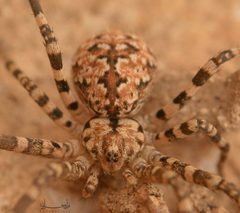
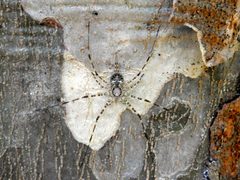
Hersiliidae are immediately recognizable by their two extremely elongated, cylindrical that extend conspicuously behind the , giving the appearance of 'tails'—this trait is diagnostic for the . The spinnerets are often held splayed or pressed together and are nearly as long as the abdomen itself. Body size ranges from approximately 10–18 mm. The is typically somewhat flattened, and the legs are long and slender, adapted for running on vertical surfaces. Coloration is generally cryptic, with mottled patterns of brown, gray, and black that blend with bark substrates; some exhibit longitudinal stripes or irregular markings that break up their outline against tree trunks.
Images
Habitat
Tropical and semi-tropical forests, with strong association to tree trunks as primary microhabitat. Specimens have been documented on bark surfaces at elevations ranging from 791–888 m in seasonal rainforest . The shows preference for forests with complex bark structure—specifically trunks with crevices, furrows, and surface irregularities that provide concealment opportunities.
Distribution
Widespread throughout most forests of the Tropical realm. Documented from Southeast Asia (including China: Yunnan, Hunan, Guizhou, Zhejiang, Guangdong, Taiwan, Chongqing, Jiangxi; Thailand; Laos; Malaysia), with additional records from the Neotropics including Uruguay. The Hersilia, the largest in the with approximately 80 extant , shows particular diversity in tropical Asian forests.
Behavior
Trunk-dwelling that exhibit cryptic on exposed tree surfaces, using bark crevices and structural irregularities for concealment despite occupying visually exposed substrates. Specimens have been observed in male-female pairs sharing the same location, suggesting association of sexes. Members of the do not spin capture webs; instead, they are ambush or active hunters on tree trunks. When prey is captured, silk is used to swathe and immobilize it. The family possesses complex silk gland anatomy with six gland types, including large numbers of aciniform glands (for prey wrapping) and tubuliform glands (for -cocoon construction).
Ecological Role
Arboreal that likely contribute to regulation of insect on tree trunks in tropical forest . Their specialized trunk-dwelling suggests they occupy a distinct microhabitat separate from both and ground-dwelling predators.
Human Relevance
Poorly documented; no significant economic or medical importance established. The 's cryptic habits and specialized make them infrequently encountered despite being relatively common in appropriate forest habitats. Some have been subjects of taxonomic and anatomical research due to their distinctive and complex silk gland evolution.
Similar Taxa
- Selenopidae (wall crab spiders)Both are dorsoventrally flattened, bark-dwelling spiders with laterigrade legs adapted for running on vertical surfaces. Distinguished by Hersiliidae's extremely elongated (absent in Selenopidae) and the presence of only two pairs of in Selenopidae versus eight in Hersiliidae.
- Sparassidae (huntsman spiders)Both are large, long-legged, non-web-building spiders found on tree trunks and walls. Sparassidae lack the conspicuous elongated of Hersiliidae and typically have a more crab-like leg posture; their arrangement (two rows of four) also differs from Hersiliidae.
- Philodromidae (running crab spiders)Both are active hunters on bark and vegetation with somewhat flattened bodies. Philodromidae have much shorter, inconspicuous and typically hold their legs in a laterigrade (crab-like) posture, unlike Hersiliidae.
Sources and further reading
- BugGuide
- GBIF taxonomy match
- iNaturalist taxon
- NCBI Taxonomy
- Catalogue of Life
- A survey of Hersilia spiders (Araneae, Hersiliidae) from Xishuangbanna, Yunnan Province, China
- Hiding in plain sight: Microhabitat selection by the trunk-dwelling spider Ypypuera crucifera (Araneae, Hersiliidae), with notes on its natural history
- Anatomie, histologie et affinités de l'appareil séricigène des Hersilia Sav. et Aud. (Araneae: Hersiliidae)
- Addition of a spider family for Uruguay: First record of Iviraiva pachyura (Mello-Leitão, 1935) (Araneae: Hersiliidae), with notes on its natural history and distribution