
Saltonia incerta
(Banks, 1898)
Rare sheet-web-weaving spider, sole representative of Saltonia. Restricted to salt crusts of intermittent or dry lakes, streams, and rivers in desert southwestern North America. Previously presumed extinct following 1905 flooding of type locality at Salton Sea, but rediscovered in 1990s at multiple sites. Genetic analyses reveal significant structure with two major clades (New Mexico versus California-northern Baja California) and minimal among isolated populations in fragmented desert salt flat .
Pronunciation
How to pronounce Saltonia incerta: //sælˈtoʊniə ɪnˈsɜːrtə//
These audio files are automatically generated. While they are not always 100% accurate, they are a good starting point.
Identification
Distinguished from other Dictynidae by specialized association with salt crusts in desert environments; colulus noted as distinctive but specific diagnostic features require examination. Tiny sheet webs constructed on underside of salt crusts serve as field indicator.
Images
Habitat
Salt crusts of intermittent or dry lakes, streams, and rivers in desert southwestern North America; specifically underside of moderate to thick salt crusts on dry lakebeds or along salty shores of wet or intermittent waterways. Requires arid environments with salt-encrusted substrates.
Distribution
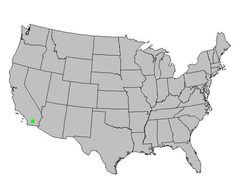
Southwestern North America: California (Death Valley/Cottonball Basin, Badwater, Tecopa, China Lake, Soda Dry Lake/Zzyzx, Bristol Lake, Cadiz Lake, Dale Lake, Danby Lake), northern Baja California (Laguna Salada, El Doctór), and New Mexico (White Sands Missile Range/Lake Otero, White Sands National Monument/Lake Lucero). Occurs across six drainage/paleodrainage basins: Amargosa/Owens, Mojave, Bristol, Colorado, and ancestral Rio Grande.
Seasonality
Observed activity in March and April based on collection records; seasonal patterns otherwise undocumented.
Behavior
Constructs tiny sheet webs on underside of salt crusts. Surface movement ('cruising around on the salt crust') has been observed. Aerial via ballooning possible but unconfirmed.
Ecological Role
Potential for past environmental changes due to highly specific requirements. Persistence in fragmented desert salt flat habitats suggests these environments may serve as refugia for terrestrial during regional aridification.
Human Relevance
Rediscovery in 1990s resolved presumed extinction status following loss of original type locality; serves as case study for persistence of rare in fragmented desert and for conservation of salt flat .