Deinopis
MacLeay, 1839
net-casting spiders, gladiator spiders, ogre-faced spiders, American Ogre-faced Spiders
Species Guides
2- Deinopis aurita(ogre-faced spider)
- Deinopis spinosa(ogre-faced spider)
Deinopis is a of net-casting spiders characterized by their distinctive hunting strategy of throwing a rectangular cribellate web at prey. The genus is distinguished by enlarged that are among the most light-sensitive of any animal, enabling hunting. These spiders exhibit specialized sensory adaptations including the use of and slit sensillae on their legs to detect prey vibrations and sounds. The genus has a tropical and subtropical distribution with a complex biogeographic history involving Gondwanan origins and subsequent events.
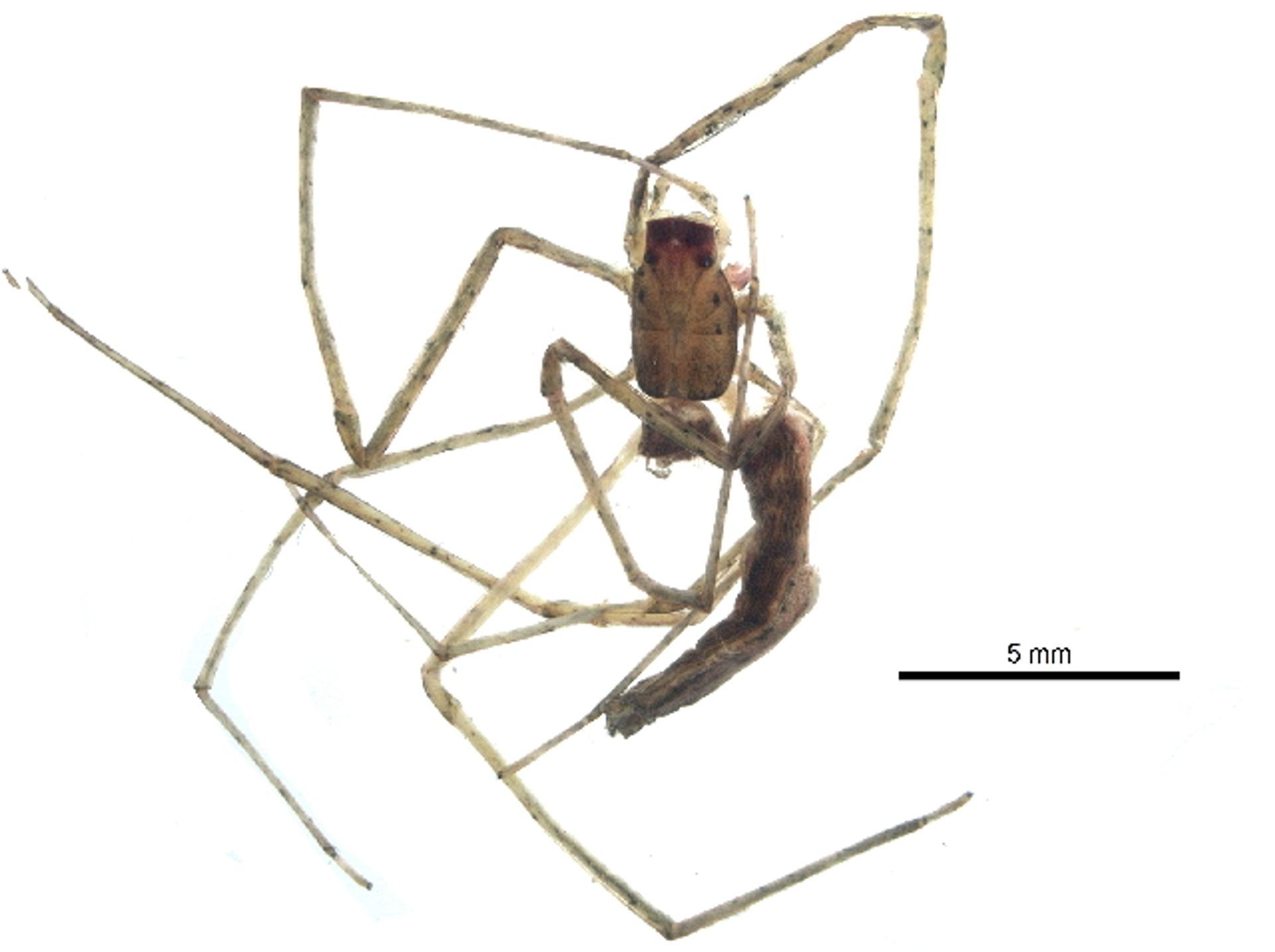
Pronunciation
How to pronounce Deinopis: //daɪˈnoʊpɪs//
These audio files are automatically generated. While they are not always 100% accurate, they are a good starting point.
Identification
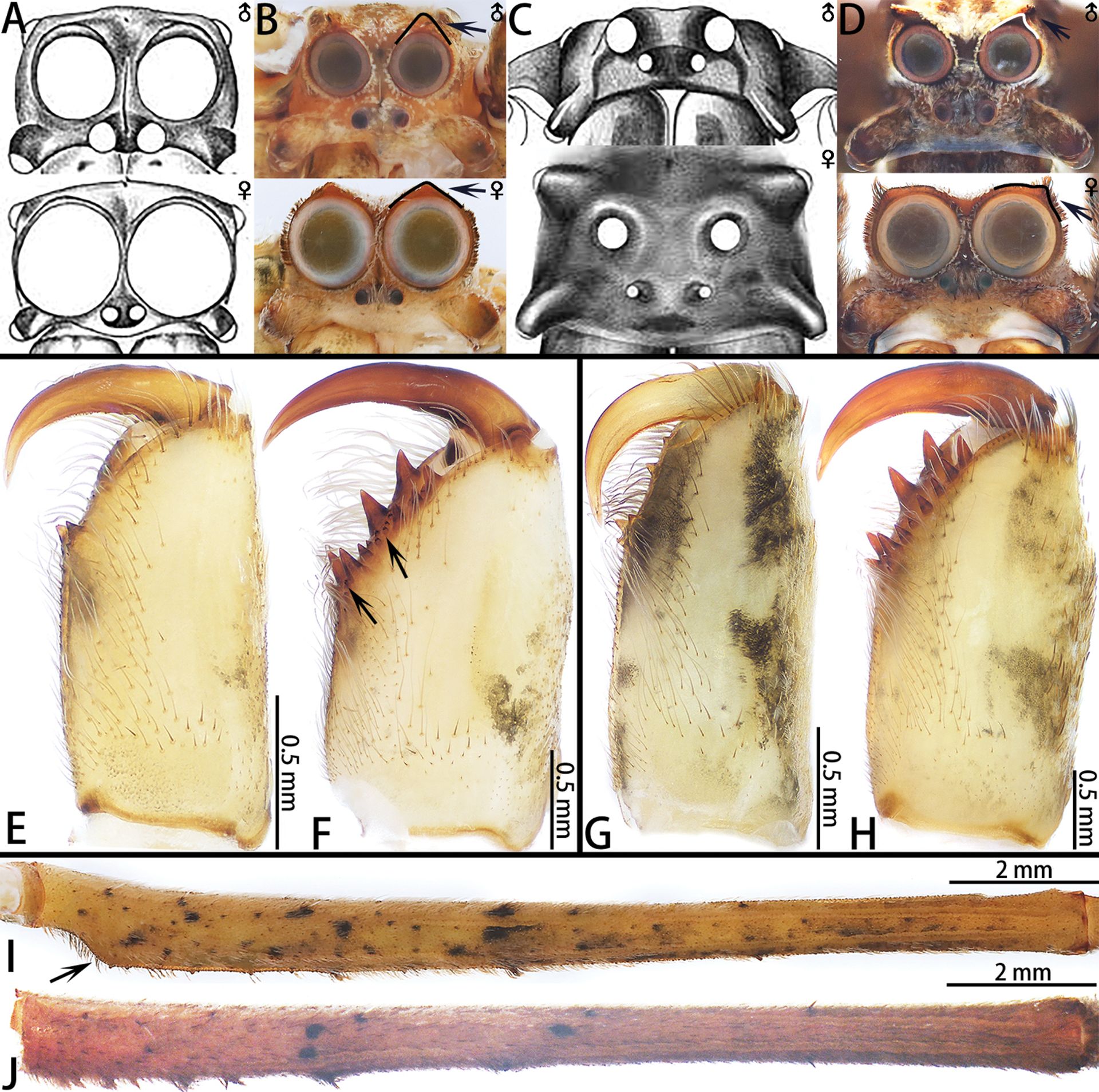
Deinopis is distinguished from other Deinopidae by the presence of greatly enlarged, forward-facing (PME). The can be separated from Asianopis by geographic distribution (New World versus Old World) and from Menneus by the presence of enlarged PMEs (Menneus lacks enlarged posterior median eyes). The combination of elongated front legs adapted for holding the capture net, ogre-like facial appearance due to eye placement, and cribellate silk production are diagnostic for the genus.
Images
Habitat
Tropical and subtropical forests. Specific observations for Deinopis cf. cylindracea indicate association with smooth tree trunks, particularly Plinia cauliflora (Myrtaceae), where occur most frequently in the lowest 50 cm of trunks closest to the ground. Daytime resting sites include vegetation near the ground where spiders adopt stick-like cryptic postures.
Distribution
Widely distributed in tropical and subtropical regions of the New World. Documented from North America (including southeastern United States), Central America, South America (including Brazil, Uruguay, Colombia), and the Caribbean. The shows a complex biogeographic pattern with ancient Gondwanan origins and subsequent overwater events.
Seasonality
activity pattern; hunting occurs at night with daytime spent in cryptic resting postures.
Diet
Prey captured using net-casting technique; both ground-dwelling and flying prey are taken. Ground prey is spotted from 1-2 meters distance followed by launching the net toward the substrate. Flying prey is located through vibrational detection.
Host Associations
- Plinia cauliflora - microhabitat associationSmooth trunks used for web construction and foraging
Behavior
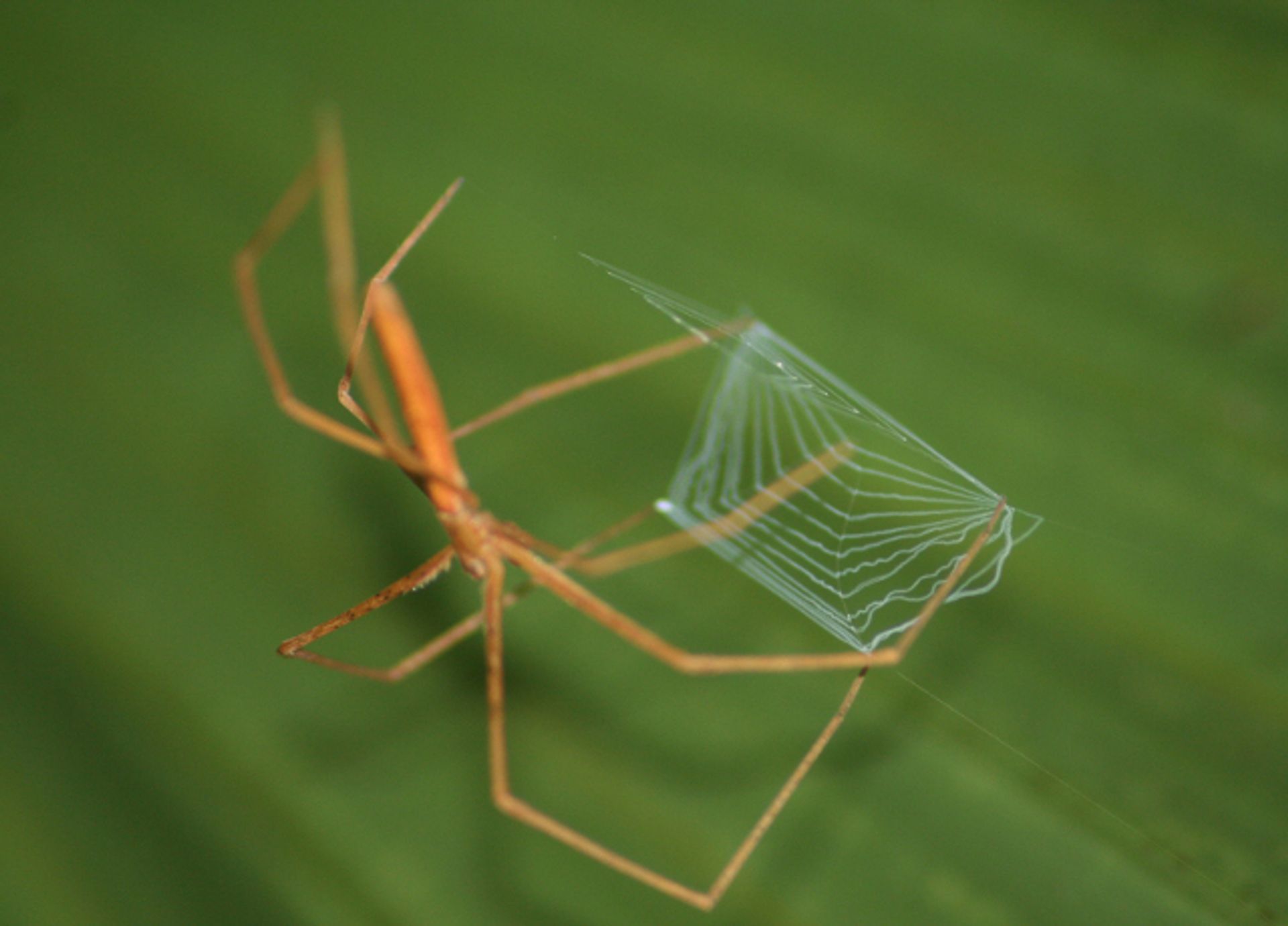
sit-and-wait . Constructs a rectangular cribellate web that is detached from supporting threads and held horizontally by the elongated front two pairs of legs while the spider hangs vertically. Prey is captured by dropping the net over passing prey. White fecal spots are placed on the substrate below the net and used for aiming. Two hunting strike styles have been observed: forward and backward strikes. During the day, adopts a stick-like cryptic posture on vegetation near the ground. Males construct Y-shaped spermatic webs for sperm induction prior to approaching females for mating.
Ecological Role
contributing to vertical stratification patterns in tree-dwelling spider . Specialized hunting strategy may reduce competition with other web-building spiders.
Human Relevance
Subject of scientific research due to exceptional visual adaptations and unique hunting . (ogre-faced spider, gladiator spider) reflect public interest in their distinctive appearance. No documented negative impacts on humans.
Similar Taxa
- AsianopisAlso ogre-faced spiders with enlarged ; distinguished by Old World distribution versus New World distribution of Deinopis
- MenneusMember of Deinopidae but lacks enlarged ; Deinopis has distinctly enlarged PMEs
More Details
Visual System
The possess extreme light sensitivity—2000 times more sensitive than human photoreceptors and more efficient at gathering light than cat or owl eyes. This is achieved through a unique mechanism: each night, a large area of light-sensitive is manufactured within the eyes and destroyed at dawn, rather than using a reflective tapetum lucidum.
Auditory Sensitivity
Can detect frequencies from 100 Hz to 1000 Hz using and slit sensillae on the legs, enabling detection of both prey insect sounds and wing beats (such as bats) at distances up to 2 meters.
Silk Production
Produces eight distinct silk types. Silk glands include paracribellate, pseudoflagelliform, and cribellar silk glands associated with cribellate silk production; pseudoflagelliform glands show with araneoid flagelliform glands.
Phylogenetic Status
Molecular phylogenetic studies indicate Deinopis is not monophyletic as currently circumscribed. The shows discordance between morphological and molecular data, with Caribbean nested within a continental grade.
Biogeographic History
Ancient lineage with origins in Gondwana; 113 Ma split into Old and New World clades. Caribbean supported by GAARlandia land bridge hypothesis during Eocene-Oligocene transition (~35-33 Ma), with additional overwater events to volcanic and sedimentary Lesser Antilles and reverse colonization of North America.
Sources and further reading
- BugGuide
- Wikipedia
- GBIF taxonomy match
- iNaturalist taxon
- NCBI Taxonomy
- Catalogue of Life
- Lisa Chamberland: About Those Ogre-Faced Spiders.... | Bug Squad
- Name That Spider Species | Bug Squad
- Silk gland morphology of the net-casting spider Deinopis spinosa
- Understanding the habitat selection and natural history of the spider Deinopis cf. cylindracea (Deinopidae)
- Egg sac construction and camouflage behaviors of Deinopis cf. cylindracea (Araneae: Deinopidae)
- Araneae, Deinopidae, Deinopis amica Schiapelli and Gerschman, 1957: First record for Uruguay and distribution map
- Reproductive behavior of Ogre-faced spider, Deinopis cf. cylindracea, in its natural habitat
- Ogre-faced Spider, Net Casting Spider, Gladiator Spider Deinopis spinosa (Marx, 1889) (Arachnida: Araneae: Deinopidae)
- Reproductive behavior of the ogre-faced spider, Deinopis cf. cylindracea (Araneae: Deinopidae), in its natural habitat
- Recent Noteworthy Distribution Records forDeinopis spinosa(Marx, 1889) (Araneae: Deinopidae) in the Southeastern United States
- The Indian net-casting spider name Deinopis goalparaensis Tikader & Malhotra is a nomen dubium (Araneae: Deinopidae)
- Web construction behavior of Deinopis cf. cylindracea (Deinopidae: Araneae) and its comparison to webs of other Deinopidae
- From Gondwana to GAARlandia: Evolutionary history and biogeography of ogre‐faced spiders (Deinopis)