
Deinopidae
C. L. Koch, 1850
Net-casting Spiders, Ogre-faced Spiders
Genus Guides
1- Deinopis(net-casting spiders)
Deinopidae is a of cribellate spiders known for their distinctive net-casting hunting strategy. They construct small rectangular capture webs held between their elongated front legs, which they stretch to two or three times their relaxed size before propelling themselves forward to entangle prey. The family includes three : Deinopis and Asianopis (ogre-faced spiders with enlarged for night vision), and Menneus (humped-back spiders lacking enlarged eyes). These spiders are sit-and-wait with excellent night vision, hunting primarily after dark while resting cryptically during daylight hours.
Pronunciation
How to pronounce Deinopidae: /daɪˈnɒpɪdiː/
These audio files are automatically generated. While they are not always 100% accurate, they are a good starting point.
Identification
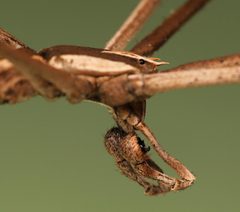
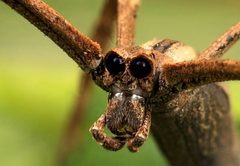
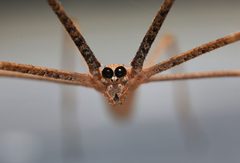
Distinguished from all other spider by the combination of: (1) elongated front legs held outstretched with a small rectangular web suspended between them, (2) dramatically enlarged (in Deinopis and Asianopis), and (3) the net-casting hunting itself. Menneus can be confused with other elongated spiders but lacks the enlarged eyes and shows the same net-casting behavior. The eye arrangement—particularly the two huge posterior median eyes—is unique among spiders and immediately diagnostic for Deinopis and Asianopis when present.
Images
Appearance
Elongated, stick-like body plan with extremely long, slender legs—particularly the front pairs used to hold capture webs. Deinopis and Asianopis possess dramatically enlarged that dominate the , giving them an ogre-like appearance; these eyes are larger than the others and sometimes make the spiders appear two-eyed. Menneus lacks these enlarged eyes and has a more conventional eye arrangement. The body is typically slender and cryptically colored to resemble twigs or vegetation. Asianopis liukuensis and related show characteristic elongated leg proportions and compact body form adapted for ambush hunting.
Habitat
Tropical and subtropical forests worldwide. select smooth-barked tree trunks and vegetation surfaces for web placement, avoiding rough substrates that could entangle the capture net. In Florida, Deinopis hangs upside-down from silk lines under palmetto fronds during the day. Asianopis liukuensis occupies forest in Southeast Asia. The shows preference for microhabitats that maximize foraging : smooth vertical surfaces near the ground where prey are largest, with occurring most frequently on lower trunk sections.
Distribution
Circumtropical distribution spanning Australia, Africa, the Americas, and Southeast Asia. Records include: Malaysia (Borneo), Philippines (Luzon, Mindanao), India, Sri Lanka, China (Yunnan—Asianopis liukuensis), Brazil (Deinopis cf. cylindracea), Uruguay (first record for Deinopis amica), and the southeastern United States (Deinopis spinosa in Florida). The easternmost record for Asianopis liukuensis is from Borneo.
Seasonality
Nocturnally active year-round in tropical . Activity peaks at night when visual hunting is optimal; spiders remain cryptically positioned on vegetation during daylight hours. In temperate regions at the northern range limits, activity likely seasonal though specific patterns not documented.
Diet
; preys on insects and other small arthropods encountered on vegetation surfaces. The net-casting method allows capture of prey that would otherwise escape conventional webs. Specific prey not comprehensively documented but likely includes beetles, flies, , and other insects.
Life Cycle
Females construct sacs using silk mixed with plant material and debris for camouflage, suspending them from vegetation by silk stalks. Females remain near egg sacs exhibiting protective . Juveniles have been observed utilizing microhabitats similar to . Detailed developmental stages and longevity not well documented.
Behavior
Net-casting: spiders hold a small rectangular web between elongated front legs, stretch it to 2-3× relaxed size, and propel themselves onto prey to entangle it. Hunting occurs exclusively at night using excellent night vision; gather light more efficiently than cats or owls despite lacking a tapetum lucidum, by manufacturing a large area of light-sensitive nightly that is destroyed at dawn. Daytime involves —adopting stick-like postures on vegetation, often hanging upside-down from silk lines. Shows active selection for smooth-barked substrates to maximize net-casting . Aggregates on lower trunk sections where prey is most abundant.
Ecological Role
Sit-and-wait that help regulate of insects on vegetation surfaces. Their specialized hunting —capturing prey that evades conventional webs—may reduce competition with other web-building spiders. sac construction with debris camouflage represents a potential food source for .
Human Relevance
Subjects of scientific interest due to unique visual adaptations and hunting ; the 'ogre-faced' appearance of Deinopis makes them memorable educational examples of spider diversity. No documented medical or economic importance. Asianopis liukuensis and other have been described in recent taxonomic works highlighting ongoing discovery in the .
Similar Taxa
- MenneusFormerly confused with Deinopis but lacks enlarged ; molecular confirms it as a distinct within Deinopidae with reduced eye size, representing a single evolutionary reduction event in the .
- AsianopisOften grouped with Deinopis as 'ogre-faced spiders' due to shared enlarged , but molecular data shows Deinopis is not monophyletic and Asianopis represents a distinct lineage with separate biogeographic history.
- Other elongated spiders (e.g., some Tetragnathidae, Deinopis-like Thomisidae)May share stick-like appearance and elongated legs, but completely lack the net-casting and the diagnostic enlarged of Deinopis and Asianopis; web architecture and eye arrangement readily distinguish them.
More Details
Eye physiology
The of Deinopis and Asianopis achieve superior night vision without a reflective tapetum lucidum. Instead, they manufacture a large area of light-sensitive within the eyes each night; because arachnid eyes lack irises, this membrane is rapidly destroyed at dawn. This temporary retinal structure allows light gathering exceeding that of cats and owls.
Phylogenetic complexity
Molecular phylogenetic studies using ultra-conserved element (UCE) and COI datasets reveal discordance between and molecular data: Deinopis is not monophyletic, Menneus is monophyletic, and the single reduction of size in deinopids occurred in the Menneus lineage. Biogeographic history reflects Western Gondwana separation and long-distance events.
Taxonomic activity
The has seen significant recent taxonomic revision. Asianopis was established as a distinct , and multiple new have been described from Southeast Asia including A. lini, A. naumenkoi, and A. apo from Borneo and the Philippines. The A. apo-group was proposed as a new species group within Asianopis.
Sources and further reading
- BugGuide
- Wikipedia
- GBIF taxonomy match
- iNaturalist taxon
- NCBI Taxonomy
- Catalogue of Life
- Lisa Chamberland: About Those Ogre-Faced Spiders.... | Bug Squad
- 100 ZooKeys papers on spiders co-authored by Shuqiang Li
- Zookeys | Blog - Part 10
- animals | Blog
- Web construction behavior of Deinopis cf. cylindracea (Deinopidae: Araneae) and its comparison to webs of other Deinopidae
- New data on Asianopis (Aranei: Deinopidae) in Southeast Asia
- Egg sac construction and camouflage behaviors of Deinopis cf. cylindracea (Araneae: Deinopidae)
- Araneae, Deinopidae, Deinopis amica Schiapelli and Gerschman, 1957: First record for Uruguay and distribution map
- Understanding the habitat selection and natural history of the spider Deinopis cf. cylindracea (Deinopidae)
- The Indian net-casting spider name Deinopis goalparaensis Tikader & Malhotra is a nomen dubium (Araneae: Deinopidae)
- Ogre-faced Spider, Net Casting Spider, Gladiator Spider Deinopis spinosa (Marx, 1889) (Arachnida: Araneae: Deinopidae)
- Reproductive behavior of the ogre-faced spider, Deinopis cf. cylindracea (Araneae: Deinopidae), in its natural habitat
- Recent Noteworthy Distribution Records forDeinopis spinosa(Marx, 1889) (Araneae: Deinopidae) in the Southeastern United States