
Myrmecotypus
O. Pickard-Cambridge, 1894
Species Guides
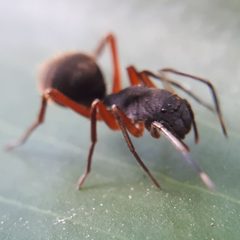
1Myrmecotypus is a of -mimicking sac spiders in the Corinnidae, Castianeirinae. exhibit myrmecomorphy—both morphological and behavioral mimicry of ants. The genus was described in 1894 and currently contains fourteen species distributed from the United States to Argentina, with greatest diversity in Central America. Most species are arboreal, though M. mazazoides is ground-dwelling.
Pronunciation
How to pronounce Myrmecotypus: //mɪrˈmɛkoʊtaɪpəs//
These audio files are automatically generated. While they are not always 100% accurate, they are a good starting point.
Identification
-mimicking spiders with body form and coloration resembling ants. M. rettenmeyeri possesses a distinctive longitudinal band of black hairs along the midline of the , enhancing resemblance to Camponotus sericeiventris. M. lineatus is the only recorded from the United States. Identification to species level requires examination of genitalia; males and females can be distinguished using modified keys from Reiskind (1969).
Images
Habitat
Predominantly arboreal. M. mazazoides is ground-dwelling in savanna-like , observed near entrances of . M. rettenmeyeri shares habitat with its ant model Camponotus sericeiventris.
Distribution
Neotropical region from United States (M. lineatus) to Argentina (M. iguazu). Primary distribution from Mexico to Panama. Bolivia, Brazil, and Nicaragua also represented.
Host Associations
- Camponotus sericeiventris - visual mimicry modelM. rettenmeyeri mimics this
- Camponotus cf. melanoticus - visual mimicry modelM. mazazoides resembles this carpenter ant
Behavior
mimicry (myrmecomorphy) involving both morphological and behavioral traits. M. mazazoides is the only known ground-dwelling in the ; all others are arboreal.
Similar Taxa
- CastianeiraRelated -mimicking spiders in Castianeirinae; Myrmecotypus distinguished by specific morphological features and geographic distribution
More Details
Taxonomic history
revised by Reiskind (1969). Recent descriptions include multiple from Bolivia (2020-2021) and Nicaragua (2014), expanding known diversity.
Etymology
name derived from Greek 'myrmex' () and 'typos' (type), referring to ant-mimicking appearance.
Sources and further reading
- BugGuide
- Wikipedia
- GBIF taxonomy match
- iNaturalist taxon
- Catalogue of Life
- The first Myrmecotypus O. P.-Cambridge (Araneae: Corinnidae) from Argentina: description of Myrmecotypus iguazu new species
- A new species of ant mimicking spider, Myrmecotypus jasmineae (Araneae: Corinnidae: Castianeirinae), from Nicaragua
- Myrmecotypus mazaxoides sp. nov. – a new ground-dwelling, carpenter ant-resembling sac spider species from the Bolivian orocline, with indirect evidence for species-specific mimicry (Araneae, Corinnidae, Castianeirinae)