
Castianeira
Keyserling, 1879
Ant-mimic Sac Spiders, Ant-mimic Spiders
Species Guides
16- Castianeira alteranda(Prairie Ant-mimic Sac Spider)
- Castianeira amoena(Orange Ant-mimic Sac Spider)
- Castianeira athena
- Castianeira cingulata(twobanded antmimic)
- Castianeira crocata(Red-spotted Ant-mimic Sac Spider)
- Castianeira crucigera
- Castianeira descripta(Red-spotted Ant-mimic Sac Spider)
- Castianeira dorsata
- Castianeira floridana
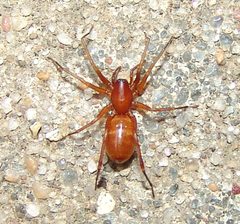
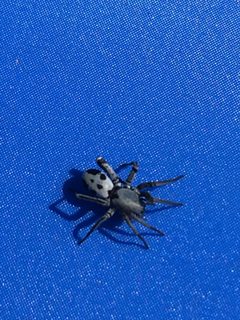
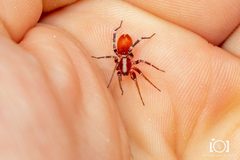
Castianeira is a of -mimicking sac spiders in the Corinnidae, first described by Eugen von Keyserling in 1879. The genus contains approximately 127 distributed across Eurasia, Africa, and the Americas, with notable diversity in North America (26 species) and Mexico/Central America. These spiders are recognized for their remarkable ant-mimicry, achieved through body shape, coloration, and behavioral adaptations.
Pronunciation
How to pronounce Castianeira: //ˌkæstəˈnaɪərə//
These audio files are automatically generated. While they are not always 100% accurate, they are a good starting point.
Identification
Distinguished from similar -mimic spiders in the Micaria by having two procurved rows of eight (upper row slightly wider than lower), whereas Micaria almost always have straight eye rows. The opisthosoma is elongate to oval, not constricted, with white -like setae contributing to ant-like appearance. Rear legs are longest, front legs second longest. Some species display pale bands on the that create the illusion of three body segments.
Images
Habitat
Woodland , particularly forest floor leaf litter. Rocky habitats in montane regions. Found in oak-hickory forests, glades, and areas with decaying logs and rock crevices.
Distribution
Eurasia, Africa, and the Americas. Absent from Australia. In North America: northeastern U.S. and adjacent southern Canada, west to South Dakota, south to Arkansas and Florida. Also documented in the northern Rocky Mountains (Wyoming, USA), Colorado, and Vermont.
Seasonality
Active both day and night during warmer months. Can overwinter in dense silken sacks spun in sheltered situations such as rock crevices and recesses of decaying logs.
Diet
Behavior
Exhibits -mimicry including slow, deliberate movement while prowling, abdominal bobbing, and waving front legs like . Some appear in the company of ants to reinforce their disguise. Mating behavior has been observed and described for the first time in the field in Wyoming, USA.
Ecological Role
. Some function as specialized predators, using mimicry to approach prey.
Human Relevance
Not recognized as dangerously venomous to people. Occasionally encountered in domestic settings such as on doorknobs.
Similar Taxa
- MicariaSimilar -mimic sac spiders, but distinguished by straight rows versus procurved rows in Castianeira.
- MyrmekaphilaOther -mimicking spiders; Castianeira may be distinguished by specific ant species mimicked and arrangement.
Sources and further reading
- BugGuide
- Wikipedia
- GBIF taxonomy match
- iNaturalist taxon
- NCBI Taxonomy
- Catalogue of Life
- Bug Eric: Spider Sunday: Twobanded Antmimic
- Bug Eric: City Nature Challenge 2023 Recap
- Bug Eric: Thankful For Small Wonders
- Love on the rocks: first field recording of mating behavior described for the genus Castianeira Keyserling, 1879 (Araneae: Corinnidae) in the northern Rocky Mountains, Wyoming, USA