
Castianeira cingulata
(C. L. Koch, 1841)
twobanded antmimic, two-banded ant-mimic sac spider
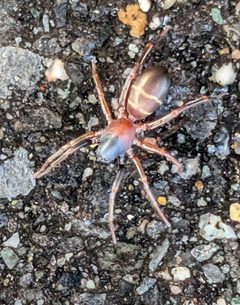
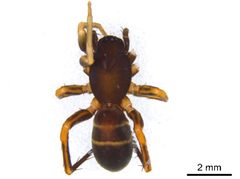
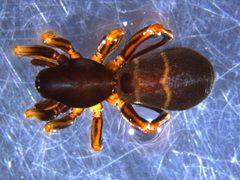
Castianeira cingulata is a small -mimicking spider in the Corinnidae, commonly known as the twobanded antmimic. Females measure 7–8 mm in body length, males 6–7 mm. The exhibits of carpenter ants through coloration, body shape, and behavioral displays including bobbing movements and foreleg waving that simulates . It inhabits woodland leaf litter across eastern North America, where it hunts insect prey.
Pronunciation
How to pronounce Castianeira cingulata: /kæˌstɪəˈnaɪrə sɪŋˈɡjuːlətə/
These audio files are automatically generated. While they are not always 100% accurate, they are a good starting point.
Identification
Small spider (6–8 mm) with two pale transverse bands on the dark , creating the illusion of three body segments rather than two. The overall dark coloration with pale banding resembles carpenter ants. Forelegs are often held forward and waved in a manner that mimics . The body is somewhat flattened and elongated compared to typical orb-weavers. Males are slightly smaller than females.
Images
Habitat
Woodland , specifically forest floor leaf litter. Also found in rock crevices and decaying log recesses where individuals construct silken sacks.
Distribution
Eastern North America: northeastern United States and adjacent southern Canada, west to South Dakota, south to Arkansas and Florida. Records also exist from India, though these may represent misidentifications or vagrant occurrences.
Seasonality
Active year-round; occur both day and night. Overwinters in dense silken sacks in sheltered situations.
Diet
Insect prey captured through active hunting in leaf litter.
Life Cycle
Constructs dense silken sacks for in sheltered microhabitats such as rock crevices and decaying log recesses. Potentially lives several years, particularly in southern portions of range.
Behavior
Exhibits deliberate, slow movement when prowling, accompanied by rhythmic bobbing. Waves forelegs in a manner that simulates . Has been observed in close proximity to actual ant colonies, reinforcing the mimetic disguise. When disturbed or seeking escape route, may display rapid, choreographed leg movements.
Ecological Role
Active in forest floor . Its -mimicry provides protection from predators that avoid aggressive, chemically-defended carpenter ants.
Human Relevance
Not dangerously venomous to humans; poses no medical threat. Occasionally encountered indoors when individuals wander from woodland .
Similar Taxa
- Castianeira spp.Other ant-mimic spiders in the same share general body form and -mimicking , but differ in banding pattern and geographic range.
- Carpenter ants (Camponotus spp.)The mimicry target; spiders distinguished by eight legs, two body segments, and lack of elbowed upon close inspection.
Sources and further reading
- BugGuide
- Wikipedia
- GBIF taxonomy match
- iNaturalist taxon
- NCBI Taxonomy
- Catalogue of Life
- Bug Eric: Spider Sunday: Twobanded Antmimic
- Bug Eric: City Nature Challenge 2023 Recap
- Nectar Robbers and Thieves Are Harming Rare Orchids in North Dakota
- Bug Eric: Thankful For Small Wonders
- 🌿 Botanizing w/ the Webster Groves Nature Study Society (WGNSS) Botany Group at Fults Hill Prairie Nature Preserve — 27 Oct 2025 | Beetles In The Bush
- November | 2025 | Beetles In The Bush