
Castianeira descripta
(Hentz, 1847)
Red-spotted Ant-mimic Sac Spider, Redspotted Antmimic
Castianeira descripta is a small -mimicking spider in the Corinnidae. It exhibits of ants, particularly carpenter ants, through body shape, coloration, and behavioral adaptations. The is distributed across the United States and Canada.
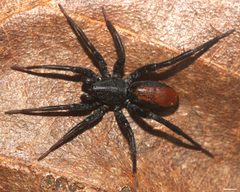
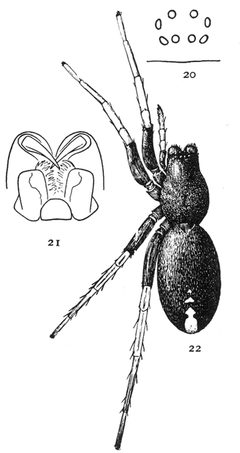
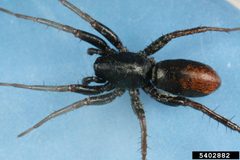
Pronunciation
How to pronounce Castianeira descripta: //kæsˌtiːəˈnaɪrə dɪˈskrɪptə//
These audio files are automatically generated. While they are not always 100% accurate, they are a good starting point.
Identification
Distinguished from other Castianeira by the presence of red or orange spots on the . C. cingulata has two pale bands rather than spots. C. longipalpis has different abdominal patterning. Ant-mimic spiders in this are separated from actual ants by the presence of eight legs (ants have six), two body segments rather than three, and the absence of . The front legs are often waved to simulate antennae.
Images
Appearance
Small spider with body length approximately 5-8 mm. Coloration and body form adapted to resemble ants, with a relatively narrow and constriction patterns that suggest the three-segmented body plan of ants. The specific epithet 'descripta' refers to its distinctive markings, which include red or orange spots on the abdomen. The overall coloration is typically dark with contrasting pale or reddish markings.
Habitat
Woodland , particularly areas with leaf litter and decaying wood. Often found in association with colonies or ant trails. Inhabits both deciduous and mixed forests where carpenter ants occur.
Distribution
United States and Canada. Documented from Alberta, Manitoba, and Ontario in Canada.
Seasonality
Active year-round in warmer regions; overwinters in dense silken retreats. Peak activity likely during warmer months when activity is high.
Behavior
Exhibits -mimicry including slow, deliberate movement, abdominal bobbing, and waving of front legs to simulate . May associate with actual ant colonies to reinforce disguise. Active hunter that does not build webs for prey capture. Constructs dense silken retreats for in sheltered locations such as rock crevices and decaying wood.
Ecological Role
of small insects and other arthropods. Its -mimicry may facilitate hunting near ant colonies or reduce risk from visually-oriented predators.
Human Relevance
Not considered dangerously venomous to humans. May be encountered in woodland recreation areas. Presence indicates healthy forest with complex leaf litter .
Similar Taxa
- Castianeira cingulataSimilar -mimic spider with two pale bands on rather than red spots; ranges overlap in eastern North America
- Castianeira longipalpisCongeneric -mimic with different abdominal patterning
- Carpenter ants (Camponotus spp.)The model organism for mimicry; distinguished by six legs, three body segments, and elbowed
More Details
Mimicry Function
The -mimicry of Castianeira descripta is considered a form of protective mimicry, as carpenter ants are aggressive, can bite fiercely, and emit formic acid—traits that make them unpalatable to many .
Taxonomic History
First described by Nicholas Marcellus Hentz in 1847, a pioneering American arachnologist who described numerous North American spider .