
Cithaeronidae
Simon, 1893
Curly-legged Ground Spiders
Genus Guides
1Cithaeronidae is a small of araneomorph spiders in the superfamily Gnaphosoidea, established by Simon in 1893. The family contains two —Cithaeron and Inthaeron—with approximately ten described . Members are small, pale yellowish, fast-moving hunters that construct silken retreats under rocks. Several species, notably Cithaeron praedonius, have been introduced to the Americas and Australia through human activity.
Pronunciation
How to pronounce Cithaeronidae: //ˌsɪθ.aɪˈrɒn.ɪˌdiː//
These audio files are automatically generated. While they are not always 100% accurate, they are a good starting point.
Identification
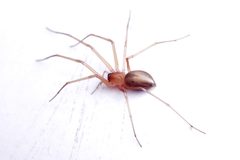
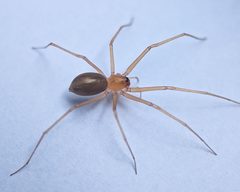
Distinguished from other gnaphosoid by the combination of depressed and pseudosegmented . The compact eye arrangement may superficially resemble Kukulcania hibernalis (Southern House Spider) or small Loxosceles (recluse spiders), but Cithaeronidae lack the violin-shaped marking of Loxosceles. Active hunting and silken retreat construction under rocks are field indicators. Definitive identification requires examination of eye and tarsal structure.
Images
Appearance
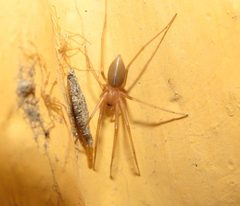
Small spiders with compact bodies. Females of Cithaeron measure 5–7 mm in length, males approximately 4 mm. Body coloration is pale yellowish. The is characterized by depressed and pseudosegmented —traits diagnostic among lower gnaphosoids. Eye arrangement is compact, potentially causing confusion with other small spiders.
Habitat
Native occupy very hot, dry stony places, constructing silken retreats beneath rocks. Introduced populations have established in environments including human housings, suburban areas, and urban structures in Florida, Brazil, and Australia.
Distribution
Inthaeron is to India. Genus Cithaeron occurs in Africa, India, and parts of Eurasia. Cithaeron praedonius has been introduced to Brazil (Piauí, Rio Grande do Sul), Australia (Northern Territory), and the United States (Florida), where breeding are established. Cithaeron reimoseri has been recorded from Eritrea and Brazil (Porto Alegre).
Seasonality
Activity patterns are primarily . In Florida, observations cluster during winter months (December–February), though this may reflect detection rather than true seasonality.
Diet
Active that hunt without webs. Cithaeron praedonius has been observed feeding on native cobweb weavers and Latrodectus geometricus (Brown Widow spiders) in captivity; may be a specialized spider predator.
Life Cycle
Females produce flat, round sacs. Spiders of various ages have been observed in introduced , indicating established breeding. Each individual constructs a silken nest for molting and resting.
Behavior
hunters that actively pursue prey on foot rather than building capture webs. retreat in silken shelters constructed under rocks or in crevices. Fast-moving and nomadic. Dispenses with silk except for retreat construction and molting chambers.
Ecological Role
, potentially specializing on other spiders. Role in native poorly documented; in introduced ranges, may impact native spider through .
Human Relevance
Accidentally introduced to multiple continents via human commerce and travel. Established breeding in Florida since at least 2011, with records from multiple counties. Frequently mistaken for medically significant spiders (Loxosceles ) due to superficial resemblance, causing unnecessary concern. Not dangerously venomous to humans or pets. Documented through citizen science platforms (BugGuide, iNaturalist, Arachnoboards), demonstrating value of public engagement in detecting non-native species.
Similar Taxa
- Loxosceles spp. (recluse spiders)Compact arrangement and pale coloration cause superficial resemblance; distinguished by lack of violin-shaped cephalic marking and diagnostic eye/tarsal characters
- Kukulcania hibernalis (Southern House Spider) males may resemble Cithaeron in size and arrangement; distinguished by tarsal structure and behavioral differences
Misconceptions
Frequently mistaken for Brown Recluse spiders (Loxosceles reclusa) due to pale coloration and compact arrangement, leading to unwarranted medical concern. Not medically significant.
More Details
Taxonomic history
established by Eugène Simon in 1893; revised by Platnick (2002) in his treatment of Australasian ground spiders.
Detection history in North America
First U.S. record from Port Richey, Florida in February 2011, identified through collaboration between citizen scientists on Arachnoboards and arachnologist G.B. Edwards. Subsequent records from multiple Florida counties confirm establishment.
Invasion biology
Cithaeron praedonius is considered prone to introduction in anthropic environments; its worldwide distribution and association with human structures facilitate accidental transport.