
Hypsosinga rubens
(Hentz, 1847)
Rubens Orbweaver
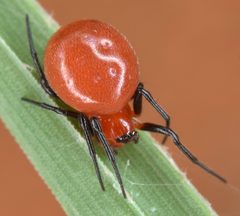
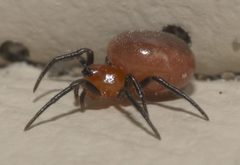
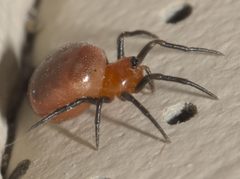
Hypsosinga rubens is a small orb-weaving spider in the Araneidae, commonly known as the Rubens Orbweaver. It is characterized by its bright red coloration and diminutive size, typically measuring only about 8 mm in length. The is distributed across the United States and Canada, where it constructs orb webs in vegetation. Despite its small size, its vivid coloration makes it one of the more visually striking members of the .
Pronunciation
How to pronounce Hypsosinga rubens: /hɪpˈsoʊsɪŋɡə ˈruːbɛnz/
These audio files are automatically generated. While they are not always 100% accurate, they are a good starting point.
Identification
are distinguished by their small size (~8 mm body length) and bright red coloration. The Hypsosinga can be separated from other small Araneidae by the combination of rounded , relatively short legs, and the presence of on the abdomen. H. rubens specifically is recognized by its uniformly red coloration, which separates it from such as H. pygmaea that typically show more patterning. The spider may be initially mistaken for dwarf spiders (Linyphiidae) due to its small size, but the orb-weaving and abdominal shape confirm placement in Araneidae.
Images
Distribution
Found in the United States and Canada. Specific state/province records are not well documented in available sources, but the appears to have a broad northern temperate distribution.
Behavior
Constructs orb webs in vegetation. One observed individual was found on the blossom of flowering dogwood (Cornus florida), suggesting use of flowering plants as web substrate.
Similar Taxa
- Hypsosinga pygmaeaSimilar small size and orb-weaving habit, but typically shows more abdominal patterning rather than uniform red coloration.
- Ceraticelus spp. (Linyphiidae)Similar small size and red coloration may cause confusion, but these are dwarf spiders that construct sheet webs rather than orb webs and have different abdominal proportions.
- Florinda coccinea (Linyphiidae)Bright red coloration and small size create superficial similarity, but this is a sheetweb spider with different web architecture and body shape.
More Details
Taxonomic History
The was originally described by Hentz in 1847. It has historically been confused with members of Linyphiidae due to its small size, leading to misidentifications in field observations.
Field Identification Challenges
The extremely small size of this makes it easy to overlook in the field. One documented observation noted that the finder initially dismissed the specimen as an due to its diminutive size and red coloration before closer examination revealed it to be an orb-weaver.