
Cyclosa walckenaeri
(O. Pickard-Cambridge, 1889)
Walckenaer's Trashline Orbweaver
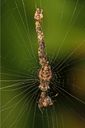
Cyclosa walckenaeri is a of trashline orb-weaver spider in the Araneidae, found from the United States through the Caribbean to Guyana. Like other members of the Cyclosa, it constructs small vertical orb webs decorated with a vertical line of debris through the center, which serves as camouflage. The spider sits at the hub of this "trashline," effectively hiding among the accumulated material. This species is part of a group of spiders known for recycling web debris and prey remains into architectural elements that disguise their presence from visual .
Pronunciation
How to pronounce Cyclosa walckenaeri: //sɪkˈloʊsə wɔːlkəˈnɛəri//
These audio files are automatically generated. While they are not always 100% accurate, they are a good starting point.
Identification
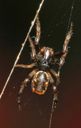
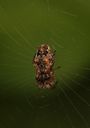
Identified as a trashline orb-weaver by the presence of a vertical line of debris, silk, and prey remains running through the center of a small orb web, with the spider positioned at the hub. Distinguished from Allocyclosa bifurca (the only other trashline in the region) by geographic distribution and potentially by abdominal —Allocyclosa bifurca is restricted to southern Texas and Florida and has a forked abdominal projection. Separated from C. conica and C. turbinata (widespread in North America) by subtle differences in abdominal shape; C. turbinata females have paired humps, while C. conica lacks these and is slightly larger. Positive identification to level may require examination of genitalia or geographic context.
Images
Habitat
Builds webs in open woodlands, shrubs, gardens, and yards. Webs are typically positioned well above ground, often at or near level (approximately 1.5-2 meters). The occupies vegetation edges and semi-open situations where vertical web placement is feasible.
Distribution
Found from the United States (specific states not documented) south through Central America to Guyana, including the Caribbean Sea region. Distribution records include Colombia (Magdalena, Meta), Cuba, and Guatemala.
Seasonality
reach maturity in spring. Specific seasonal activity patterns beyond this are not documented for this .
Life Cycle
Mated females produce up to five sacs, hidden on twigs or beneath foliage. Mature males do not construct webs and wander in search of mates. Further details specific to this are not documented.
Behavior
Constructs and maintains a vertical trashline through the web center, incorporating old prey, newly captured prey, and other debris. The spider sits at the hub, camouflaged among items matching its body size and shape. This reduces detection by visual such as birds. The spider likely remains at the hub during daylight hours, with possible activity patterns typical of many orb-weavers.
Ecological Role
Serves as a of small flying insects captured in its orb web. The trashline decoration may also provide microhabitat for other small arthropods. As a small spider, it likely functions as prey for larger , birds, and other vertebrates.
Human Relevance
Not medically significant; bites to humans are not documented and unlikely given small size. Webs may be encountered in gardens and residential areas but are not considered a nuisance. The contributes to natural pest control by capturing small flying insects.
Similar Taxa
- Cyclosa conicaWidespread North American with similar trashline web structure; females slightly larger (5.3-7.5 mm) and lack abdominal humps. Geographic overlap in eastern and central North America.
- Cyclosa turbinataWidespread North American with paired humps on female ; otherwise similar trashline and web structure. Difficult to distinguish without close examination.
- Allocyclosa bifurcaOnly other trashline orb-weaver in the region; distinguished by forked abdominal projection, silvery-white coloration, and restriction to southern Texas and Florida; builds webs close to ground, often in prickly pear cactus.
More Details
Etymology
The specific epithet walckenaeri honors Charles Athanase Walckenaer (1771-1852), a French arachnologist who made significant contributions to early spider .
Taxonomic Note
Originally described as Turckheimia walckenaerii by O. Pickard-Cambridge in 1889 before transfer to Cyclosa. NCBI records the epithet as walckenaerii with double 'i', though the original and accepted spelling per Catalogue of Life is walckenaeri.
Research Status
Like many Neotropical Cyclosa , detailed natural history studies are lacking. Most behavioral and ecological inferences derive from studies of better-known in North America and Europe.
Sources and further reading
- BugGuide
- Wikipedia
- GBIF taxonomy match
- iNaturalist taxon
- NCBI Taxonomy
- Catalogue of Life
- Bug Eric: Spider Sunday: Trashline Orb Weavers
- Orbs, Tangles, and Sheets: Spider Web Styles Linked to Anti-Predator Adaptations
- Bug Eric: June 2012
- Marronoids: The (Mostly) Little Brown Spiders With a Big Story to Tell
- Bug Eric: One Night, One House, Seventeen Spider Species
- Bug Eric: Spider Sunday: Featherlegged Orb-weavers