
Carios kelleyi
Cooley & Kohls, 1941
Carios kelleyi is a ( Argasidae) that parasitizes bats, primarily the big brown bat (Eptesicus fuscus). First described in 1941, this has been documented across much of North America and has been recorded in at least 29 of the 48 conterminous United States, plus Canada and Cuba. The species has gained attention due to its association with human dwellings when bats roost in attics and structures, and its potential to bite humans when primary bat are removed. Recent studies have identified rickettsial agents in C. kelleyi, including lusitaniae (first U.S. detection), 'Candidatus Rickettsia andeanae', and a Rickettsia parkeri-like agent, raising public health concerns about its potential.
Pronunciation
How to pronounce Carios kelleyi: //ˈkɛəri.oʊs ˈkɛli.aɪ//
These audio files are automatically generated. While they are not always 100% accurate, they are a good starting point.
Identification
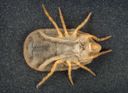
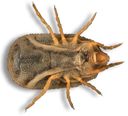
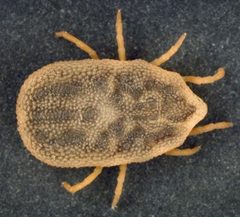
Carios kelleyi is a () distinguished from hard ticks (ixodids) by the lack of a and the presence of a leathery, wrinkled . Within Argasidae, it can be identified to by larval and characteristics as described by Cooley and Kohls (1941). Larvae collected from big brown bats (Eptesicus fuscus) in New Jersey were identified using standard taxonomic keys for argasid ticks.
Images
Habitat
Bat roosts, including natural caves, tree hollows, and human-made structures such as residential attics, barns, and buildings where bats establish colonies. Documented infesting private residences with histories of bat occupancy.
Distribution
Widely distributed across North America. Recorded in at least 29 of 48 conterminous U.S. states including California, Indiana, Iowa, Kansas, Kentucky, New Jersey, Ohio, and Texas. Also documented in Saskatchewan, Canada; Montana, USA; Cuba; and Rica.
Diet
Blood-feeding on mammalian , primarily bats.
Host Associations
- Eptesicus fuscus - primary big brown bat; documented in New Jersey, Saskatchewan, and Montana
- various bat species - previously known include multiple bat
Behavior
Ecological Role
of bats with potential role as for rickettsial agents. The detection of lusitaniae, 'Candidatus Rickettsia andeanae', and a Rickettsia parkeri-like agent suggests possible involvement in peridomestic Rickettsia transmission cycles, though vector competence has not been confirmed.
Human Relevance
Public health concern due to potential to bite humans when bat are excluded from dwellings. Documented in human housing in Kansas and New Jersey. Associated with rickettsial agents including lusitaniae (first U.S. record in this ), raising concerns about possible transmission. The ' association with bats that regularly roost in human-made structures underscores the need for awareness during bat exclusion and pest management activities.
Similar Taxa
- other Carios speciescongeneric soft ticks that also parasitize bats; require morphological examination for differentiation
- Ornithodoros speciesother argasid ticks with similar soft-bodied appearance; distinguished by specific morphological features and associations
Sources and further reading
- BugGuide
- GBIF taxonomy match
- Catalogue of Life
- The Best of 2020 on Entomology Today
- New plant species a microcosm of biodiversity | Blog
- Pensoft Editorial Team | Blog - Part 130
- First Record of Carios kelleyi (Acari: Ixodida: Argasidae) in New Jersey, United States and Implications for Public Health
- First Record of Hosts for TickCarios kelleyi(Acari: Ixodida: Argasidae) in Canada and Montana : Table 1
- Carios kelleyi (Acari: Ixodida: Argasidae) Infected With Rickettsial Agents Documented Infesting Housing in Kansas, United States
- First Record of Hosts for Tick <I>Carios kelleyi</I> (Acari: Ixodida: Argasidae) in Canada and Montana