
Argas
Bat-ticks
Argas is a of soft ticks in the Argasidae, containing 44 across two subgenera: Argas and Persicargas. These ticks lack the hard shield characteristic of hard ticks (Ixodidae) and exhibit distinctive feeding , taking multiple short blood meals rather than prolonged single feedings. The genus includes species with exceptional longevity—Argas brumpti individuals have survived 27 years in laboratory conditions and endured eight years without feeding. Argas species serve as for -borne including those causing tick-borne .
Pronunciation
How to pronounce Argas: /ˈɑr.ɡæs/
These audio files are automatically generated. While they are not always 100% accurate, they are a good starting point.
Identification
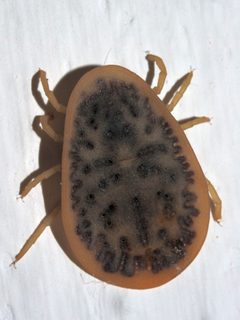
Soft ticks in this lack the hard ( shield) present in hard ticks (Ixodidae). The body is leathery and wrinkled, with the mouthparts located ventrally rather than anteriorly as in hard ticks. Argas typically appear flattened and oval when unfed. Species identification requires examination of subtle morphological features including , leg segmentation, and body setation patterns. The subgenera Argas and Persicargas are distinguished by structural differences in the and spirocular plates.
Images
Habitat
occupy diverse including animal burrows, dust baths, mounds, bird nests, and poultry housing. Argas brumpti inhabits arid regions of eastern and southern Africa, congregating near sleeping sites. Argas persicus occurs across the Palearctic region in association with poultry and wild bird habitats.
Distribution
Widespread across Africa, Europe, Asia, and North America. Argas brumpti is native to arid regions of eastern and southern Africa. Argas persicus has broad Palearctic distribution including Kazakhstan, Algeria, Egypt, and northwestern China. Multiple including A. japonicus, A. persicus, A. reflexus, and A. vulgaris have predicted suitability across China.
Diet
Blood-sucking that feed on mammals, birds, and reptiles. Soft ticks in this take multiple short, fast meals rather than the prolonged single feedings characteristic of hard ticks. Argas persicus has been observed to repeat blood-feeding within nymph or stages.
Life Cycle
includes , larva, and multiple nymphal stages (typically two or more, each requiring a blood meal) before reaching adulthood. The transition between stages requires blood meals, and the complete cycle may extend to three years. Argas brumpti females have demonstrated after extended sperm storage—females produced offspring four years after the last male died, indicating long-term sperm retention until blood meals trigger .
Behavior
Soft ticks do not exhibit questing typical of hard ticks. Instead, they remain in -associated refugia (burrows, nests, roosts) and feed rapidly when hosts are present. Argas brumpti has demonstrated exceptional starvation , surviving eight years without feeding in laboratory conditions. The shows remarkable longevity, with individuals living 27 years and second- offspring surviving 26 years.
Ecological Role
for -borne affecting humans and animals, including Borrelia causing tick-borne . Argas persicus facilitates pathogen spread through human-mediated transport with poultry trading. Genetic exchange between geographically distant occurs through animal trading networks.
Human Relevance
Medical and veterinary importance as . Argas persicus is a significant pest of poultry. Argas brumpti is not known to transmit disease. Laboratory colonies serve research purposes—Shepherd's 45-year colony at Binghamton University provided critical data on longevity and reproductive .
Similar Taxa
- CariosAlso in Argasidae; both lack hard and have mouthparts. Carios are primarily bat-associated, while Argas has broader range including birds and mammals.
- Ornithodoros with similar soft-bodied and rapid feeding . Distinguished by subtle differences in structure and preferences—Ornithodoros more commonly associated with ground-dwelling mammals.
- IxodesHard with prominent , mouthparts, and prolonged feeding . Ixodes exhibit questing behavior on vegetation, unlike Argas which remains in refugia.
Sources and further reading
- BugGuide
- Wikipedia
- iNaturalist taxon
- NCBI Taxonomy
- Catalogue of Life
- It Started Out as a Quiet, End-of-the-Year Hike Near Lake Berryessa... | Bug Squad
- Bugs Reign Supreme at UC Davis Picnic Day | Bug Squad
- Argas brumpti drawing - Entomology Today
- Argas brumpti female - Entomology Today
- Keep on Ticking: Entomologist Tells of Ticks' 27-Year Lifespan
- Argas brumpti Archives - Entomology Today
- Predicting the potential habitat for Argas japonicus, Argas persicus, Argas reflexus, Argas vulgaris and Carios vespertilionis tick species in China
- Insight into the genetic diversity of Hyalomma scupense, Ixodes persulcatus, Haemaphysalis punctata and Argas persicus in Kazakhstan.