
Trisetacus
Keifer, 1952
Species Guides
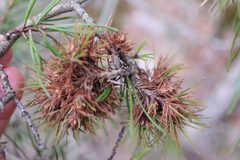
1Trisetacus is a of eriophyoid mites (Eriophyoidea: Phytoptidae, historically placed in Nalepellidae) that are obligate of coniferous trees. within this genus exhibit strong specificity, primarily infesting members of Pinaceae and Cupressaceae. The genus includes species with diverse feeding habits: some inhabit needle , others infest foliage, buds, or seeds. Molecular phylogenetic studies have revealed a deep dichotomy within Trisetacus, with two major lineages distinguished by female genital and host associations—one lineage associated with Pinaceae and another with Cupressaceae. Several species are significant forest pests, causing damage ranging from needle and twisting to complete destruction of seed crops. The genus has been subject to taxonomic revision, with 22 species recognized from North America alone.
Pronunciation
How to pronounce Trisetacus: /traɪˈsɛtəkəs/
These audio files are automatically generated. While they are not always 100% accurate, they are a good starting point.
Identification
identification relies on detailed morphological examination, particularly of the prodorsal shield pattern, structure, and solenidia. in tarsal appendages has been documented: for example, in T. abietis, females possess long asymmetrical 8/7-rayed empodia while males have shorter symmetrical 6/6-rayed empodia and shorter solenidia ω I. Some species exhibit morphological dimorphism in body size ("long form" and "short form"), suggesting complex . Molecular identification using COI and 18S/28S rRNA gene sequences is increasingly employed, though careful verification of reference sequences is necessary due to misidentifications in public databases.
Images
Habitat
Coniferous forests and plantations; are found on foliage, needle , buds, and seeds of trees. Specific microhabitats vary by species: T. campnodus causes and twisting of Pinus contorta foliage; T. confusus and T. brevisetus inhabit needle sheaths of pines; T. cedri occurs in buds of Cedrus deodara; seed-inhabiting species such as T. quadrisetus and T. indelis are found within juniper berries.
Distribution
Widespread across the Northern Hemisphere. Documented from North America (including western USA, British Columbia, and eastern regions), Europe (including Crimea, Abkhazia, Poland, Denmark, Norway, Sweden), and South Africa (introduced of T. cedri on Cedrus deodara). Specific have restricted distributions: T. quadrisetus in British Columbia was known only from a single locality on Vancouver Island; T. confusus is to Crimea; T. brevisetus occurs in Crimea, Georgia, and the Caucasus.
Seasonality
Year-round activity has been observed in some . T. campnodus may spread at any time of the year. Seasonal patterns likely vary with and local climate conditions, though specific data are sparse for most species.
Diet
Obligate plant feeding on conifer tissues. Specific feeding sites vary: foliage parenchyma (T. abietis, T. campnodus), needle (T. confusus, T. brevisetus), buds (T. cedri), seeds and berries (T. quadrisetus, T. indelis). Feeding causes characteristic damage including , needle twisting, brown cross-stripes, or seed destruction.
Host Associations
- Abies alba - silver fir; of T. abietis
- Abies nordmanniana - Nordmann fir; of T. abietis in Abkhazia
- Cedrus deodara - deodar cedar; of T. cedri in Abkhazia and South Africa
- Juniperus californica - California juniper; of T. indelis
- Juniperus occidentalis - western juniper; of T. indelis
- Juniperus osteosperma - Utah juniper; of T. indelis
- Juniperus scopulorum - Rocky Mountain juniper; of T. quadrisetus
- Pinus brutia subsp. pityusa - Turkish pine ; of T. brevisetus
- Pinus contorta - lodgepole pine; of T. campnodus
- Pinus nigra subsp. pallasiana - Crimean pine; of T. confusus
- Cupressaceae - including Thuja, Cupressus, Chamaecyparis; of multiple
- Pinaceae - including Abies, Cedrus, Pinus; of multiple
Ecological Role
Specialized of conifers with significant impacts on . Seed-destroying such as T. quadrisetus and T. indelis can practically eliminate seed production of individual trees, potentially affecting forest and food availability for wildlife. The represents an ancient lineage of eriophyoid mites associated with gymnosperms, contributing to understanding of host-parasite and the evolutionary history of conifers.
Human Relevance
Several are forest pests of economic and ecological concern. T. quadrisetus causes severe damage to juniper berry crops, destroying seeds and eliminating seed production on affected trees. T. campnodus damages Pinus contorta seedlings and plantations, with interior provenances more seriously affected than coastal provenances. T. indelis damages seeds of North American junipers. The potential for introduction and establishment in new areas exists: T. campnodus, naturally coastal, may become established in interior areas if introduced. Taxonomic and phylogenetic studies of Trisetacus have highlighted issues with misidentified sequences in public databases, emphasizing the need for careful curation of molecular data.
Similar Taxa
- NalepellaBoth belong to Nalepellinae and are associated with Pinaceae; molecular phylogenetic analyses have recovered a clade comprising Trisetacus and Nalepellinae (Nalepella + Setoptus)
- SetoptusBoth belong to Nalepellinae and share conifer associations; historically confused in GenBank sequence annotations
- EriophyesSome Trisetacus were historically placed in Eriophyes (e.g., T. quadrisetus as Eriophyes quadrisetus); both are eriophyoid mites but Trisetacus is distinguished by conifer specialization and morphological features
- NovophytoptusShares in tarsal appendages with T. abietis; both represent endoparasitic lineages, though on different (monocots vs. conifers)
Sources and further reading
- BugGuide
- GBIF taxonomy match
- iNaturalist taxon
- NCBI Taxonomy
- TWO NEW SPECIES OF TRISETACUS (PROSTIGMATA: ERIOPHYOIDEA) ASSOCIATED WITH CUPRESSACEAE
- UNUSUAL NEW SPECIES OF TRISETACUS (PROSTIGMATA: ERIOPHYOIDEA) ASSOCIATED WITH CUPRESSACEAE IN NORTH AMERICA
- Notes on the Juniper Berry Mite, Trisetacus quadrisetus (Thomas) (Acarina: Eriophyidae), in British Columbia
- Trisetacus (Acarina: Eriophyoidea) on Pinuscontorta in British Colombia: distribution, symptoms, and provenance effect
- REVIEW OF SPECIES OF TRISETACUS (ACARI: ERIOPHYOIDEA) FROM NORTH AMERICA, WITH COMMENTS ON ALL NOMINATE TAXA IN THE GENUS
- Morphological descriptions and DNA barcodes of Oziella viscida n. sp. (Eriophyoidea, Phytoptidae) and two infrequently reported Trisetacus species (Nalepellidae) from Crimea
- Über eine in den Nadeln der Weißtanne (Abies alba Mill.) lebende Gallmilbe, Trisetacus abietis n. sp. (Eriophyidae, Acarina)
- Genetic and morphological diversity of Trisetacus species (Eriophyoidea: Phytoptidae) associated with coniferous trees in Poland: phylogeny, barcoding, host and habitat specialization
- Phylogenetic Position of a New Trisetacus Mite Species (Nalepellidae) Destroying Seeds of North American Junipers and New Hypotheses on Basal Divergence of Eriophyoidea
- <p class="Body"><strong>Supplementary descriptions and DNA barcodes of two rarely encountered <em>Trisetacus</em> species (Eriophyoidea, Phytoptidae) associated with Tertiary relict conifers from the Mediterranean region</strong></p>
- Molecular phylogenetic analyses reveal a deep dichotomy in the conifer-inhabiting genus Trisetacus (Eriophyoidea: Nalepellidae), with the two lineages differing in their female genital morphology and host associations