
Eriophyes
C.Th.von Siebold, 1851
blister mites
Species Guides
10- Eriophyes betulae(Birch gall mite)
- Eriophyes cerasicrumena(Black Cherry Leaf Gall Mite)
- Eriophyes emarginatae(Plum Finger Gall Mite)
- Eriophyes leiosoma(Lime Felt Gall Mite)
- Eriophyes lepidosparti(Scalebroom Bud Mite)
- Eriophyes mali(apple blister mite)
- Eriophyes neoessigi(cottonwood catkin gall mite)
- Eriophyes prunidemissae
- Eriophyes pyri(pearleaf blister mite)
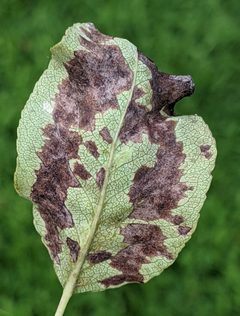
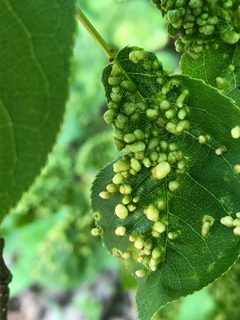
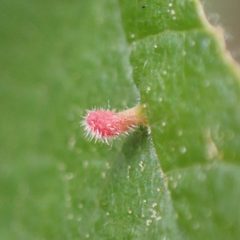
Eriophyes is a of eriophyid mites known for inducing gall formation on plants. Unlike most mites, possess only two pairs of legs rather than four. The genus includes economically significant pests such as Eriophyes dimocarpi, which causes longan witches' broom in Vietnam, and Eriophyes pyri, the pear leaf blister mite. feed by piercing plant to access sap, with saliva that triggers distinctive plant growth including blisters, curls, and witches' broom formations.
Pronunciation
How to pronounce Eriophyes: /ˌɛr.iˈɒf.i.iːz/
These audio files are automatically generated. While they are not always 100% accurate, they are a good starting point.
Identification
distinguished from other mites by possessing only two pairs of legs (most other mites have four pairs). Extremely small body size typical of eriophyid mites. Specific identification requires microscopic examination and association with plant and gall .
Images
Habitat
Within plant tissue, specifically inside galls formed on leaves, buds, or shoots of plants. Some inhabit leaf where gall formation is initiated.
Distribution
distribution with records from Europe, Asia, Africa, North America, South America, Australasia, and the Pacific Islands. Specific distribution varies by ; Eriophyes pyri occurs across multiple continents including Europe, North America, South America, Africa, Asia, and Australasia.
Diet
Plant sap obtained by piercing plant . Feeding occurs within galls on leaf tissue, buds, or shoots.
Host Associations
- Dimocarpus longan - Eriophyes dimocarpi causes witches' broom
- Lycium chinense - Eriophyes kuko
- Mangifera indica - Eriophyes mangiferae, mango bud mite associated with malformation
- Medicago sativa - Eriophyes medicaginis causes witches' broom on alfalfa
- Pyrus spp. - Eriophyes pyri, pear leaf blister mite
- Malus spp. - Eriophyes pyri also attacks apple
- Prunus spp. - Eriophyes pyri also attacks plum
Life Cycle
Six developmental stages observed in Eriophyes kuko: , , nymphochrysalis, deutonymph, teleiochrysalis, and . Development from egg to adult averages 7.5 days in June for this . adults emerge from galls on mature leaves, disperse by crawling or wind to stems, climb to young leaves, and induce new gall formation where they mature and reproduce.
Behavior
Induces gall formation on plants through salivary secretions that alter plant growth. Galls typically form along leaf or in buds. occurs via crawling or wind transport from mature to young plant tissue. Some show high densities during specific periods; Eriophyes medicaginis reaches peak densities from mid-September to mid-March in Greece.
Ecological Role
Gall-forming that manipulates plant tissue development. Creates protected microhabitats within plant structures. Eriophyes dimocarpi serves as prey for the Celastrina serotina, one of few known Lepidoptera.
Human Relevance
Significant agricultural pests causing substantial crop losses. Eriophyes dimocarpi threatens longan production in Vietnam's Mekong Delta, with potential to spread to rambutan. Eriophyes mangiferae associated with mango malformation . Eriophyes pyri damages pear, apple, and plum orchards globally. Control methods include sulfur, neem oil, petroleum oil, and biological agents such as . Phostoxin has been evaluated for control in mango buds.
Similar Taxa
- Other Eriophyidae generaSimilar microscopic size and gall-forming habit; distinguished by leg number (two pairs in Eriophyes versus variable in related ) and specific gall on particular plants
- Aprostocetus eriophyesHomonym confusion: this is a (Eulophidae), not a mite; belongs to entirely different class (Insecta/Hymenoptera versus Arachnida/Acari)
Sources and further reading
- BugGuide
- Wikipedia
- GBIF taxonomy match
- iNaturalist taxon
- NCBI Taxonomy
- Catalogue of Life
- Eriophyes dimocarpi - Entomology Today
- Eriophyes dimocarpi Archives - Entomology Today
- New Guide Details Pest-Management Practices for Longan
- longan with witches' broom - Entomology Today
- Phostoxin™ for Control of Eriophyes mangiferae (Acarina: Eriophyidae) Associated with Malformation Disease in Mango Phostoxin trademark for Control of Eriophyes mangiferae (Acarina: Eriophyidae) Associated with Malformation Disease in Mango
- Biology of Eriophyes kuko KISHIDA (Acarina: Eriophyidae)
- The biology of the grape bud miteEriophyes vitis(PGST.)
- The bermudagrass mite Eriophyes cynodoniensis (Sayed) (Acari: Eriophyidae) in Florida with reference to its injury symptomology, ecology, and integrated control /
- Eriophyes pyri . [Distribution map].
- Panonychus citri (MacGregor) (Tetranychidae) and Eriophyes medicaginis K. (Eriophyidae): Two important phytophagous mites recorded for the first time in Greece
- Eriophyes pyri . [Distribution map].
- New eriophyoid mites (Acari: Eriophyoidea) from sedges in Poland and supplement description of Eriophyes lentiginosus Mitrofanov, Sharonov et Sekerskaja, 1983