
Anystinae
Genus Guides
1- Anystis(Whirligig Mites)
Anystinae is a of prostigmatic mites in the Anystidae. These fast-moving mites are commonly known as whirligig mites due to their rapid, erratic movement patterns. Members of this subfamily are primarily predatory and are frequently observed in terrestrial . The subfamily includes the well-known *Anystis*, which contains that are commercially used for biological pest control.
Pronunciation
How to pronounce Anystinae: //ˌænɪˈstaɪniː//
These audio files are automatically generated. While they are not always 100% accurate, they are a good starting point.
Identification
Distinguished from other Anystidae by the combination of: long, slender legs enabling characteristic rapid whirling movement; generally larger body size compared to related prostigmatic mites; and the presence of two pairs of (when visible). The *Anystis* can be recognized by its bright coloration and extremely fast, circular running patterns. Separation from *Erythracarinae* requires examination of leg chaetotaxy and palpal structure.
Images
Appearance
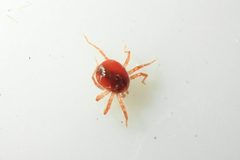
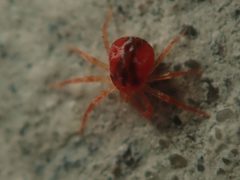
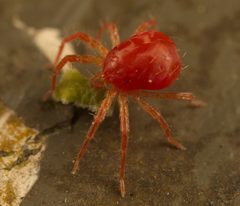
Small to medium-sized mites, generally 1-2 mm in length. Body typically oval to elongate-oval in shape. Legs are long and slender relative to body size, adapted for rapid running. Coloration often bright red, orange, or yellow, though some are brown or greenish. are prominent and stylet-like, adapted for . Setae are usually sparse to moderate in .
Habitat
Predominantly terrestrial including soil surface, leaf litter, grasses, and low vegetation. Often found in agricultural fields, orchards, gardens, and disturbed open habitats. Some occur on woody plants and shrubs. Generally favors warm, sunny conditions with exposed surfaces suitable for rapid movement.
Distribution
Worldwide distribution with records from all continents except Antarctica. Particularly well-represented in temperate and subtropical regions. The *Anystis* has been introduced to multiple regions for purposes.
Seasonality
Active primarily during warmer months; peak activity in spring and summer in temperate regions. Some may be active year-round in tropical and subtropical climates. stages may occur in soil or protected microhabitats.
Diet
Predatory, feeding on small arthropods and . Documented prey includes spider mites (Tetranychidae), , aphids, small insect larvae, and other mites. Some may supplement diet with pollen or fungal spores, though is the primary feeding mode.
Life Cycle
Development includes , larva, , deutonymph, tritonymph, and stages. All active stages are predatory. No hypopal (phoretic) stage occurs. time varies with temperature, ranging from several weeks to months. Females deposit eggs in soil or on vegetation.
Behavior
Characterized by extremely rapid, erratic running movements in circular or zigzag patterns—hence the 'whirligig mites.' This movement pattern is thought to aid in prey detection and avoidance. Non-web-building; active hunters that pursue or ambush prey. Often seen running quickly across exposed soil surfaces, leaves, or other substrates in warm conditions.
Ecological Role
Important in agricultural and natural . Contribute to of pest mites and small insects. Serve as prey for larger arthropods and small vertebrates. Influence of phytophagous mites in cropping systems.
Human Relevance
Several , particularly in the *Anystis*, are commercially produced and sold for biological pest control in agriculture and horticulture. Used for management of spider mites, , and other small pests in greenhouse and field crops. Non-venomous and harmless to humans; does not bite or transmit .
Similar Taxa
- ErythracarinaeAlso in Anystidae; distinguished by different leg chaetotaxy and generally less rapid movement. Erythracarines often have more setose bodies and different palpal structures.
- Bdellidae (snout mites)Similar predatory mites with rapid movement; distinguished by elongated snout-like rostrum and different cheliceral structure. Bdellids also have a characteristic jerky movement pattern distinct from the whirling gait of Anystinae.
- CunaxidaeFast-running predatory mites sometimes confused with anystines; distinguished by presence of a palpal thumb-claw complex and different body proportions.
More Details
Biological Control Use
of *Anystis* (particularly *Anystis baccarum* and related ) are among the few predatory mites commercially available for . They are valued for their ability to consume large numbers of pest mites and their of warmer, drier conditions compared to many phytoseiid .
Taxonomic Note
The of Anystinae has been historically unstable, with various moved between . Recent molecular studies have helped clarify relationships within Anystidae, though some generic boundaries remain under revision.