
Bdellidae
Snout Mites
Subfamily Guides
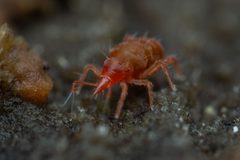
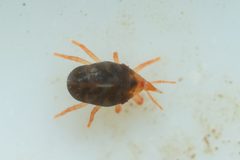
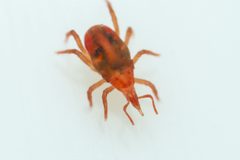
4Bdellidae is a of moderate to large-sized predatory mites commonly known as snout mites. The family contains approximately 11 and at least 278 described worldwide. They are distinguished by their elongated, snout-like gnathosoma and elbowed bearing two long terminal setae (one in the genus Monotrichobdella). Members inhabit diverse environments including soil, leaf litter, vegetation, and intertidal zones.
Pronunciation
How to pronounce Bdellidae: /ˈdɛlɪˌdaɪ/
These audio files are automatically generated. While they are not always 100% accurate, they are a good starting point.
Identification
Easily recognized by the combination of an elongated, snout-like gnathosoma and elbowed bearing two long terminal setae. The Monotrichobdella is distinguished by having only one terminal seta on the pedipalp. -level identification requires examination of genital system anatomy and structure.
Images
Appearance
Medium to large-sized mites with an elongated, snout-like gnathosoma. are elbowed and bear two long terminal setae (reduced to one in Monotrichobdella). Body form adapted for predatory lifestyle.
Habitat
Soil, leaf litter, leaves, and intertidal rocks. Occupies both terrestrial and coastal intertidal environments.
Distribution
Worldwide distribution. Documented from Europe, Morocco, Australia, South Africa, China, and Scandinavia (Denmark, Norway, Sweden). Specific distribution varies by ; some have been introduced to new regions for purposes.
Diet
Predatory. Known to prey on Collembola, including (). Some appear able to utilize alternative food sources during periods of prey scarcity.
Life Cycle
Development includes and active stages. Eggs are deposited at sheltered sites using an ovipositor. Egg varies among : typically spiny, globular, and reddish; flat lenticular in Biscirus; thin-shelled globular with protective covering in Spinibdella cronini; globular tuberculated whitish without spines in Bdellodes longirostris. Eggs can mature without insemination. Complete ontogeny described for Bdella muscorum.
Behavior
that actively pursue prey. Some have been employed as agents against agricultural pests.
Ecological Role
of small arthropods, particularly Collembola. Some function as agents in agricultural systems, with documented cases of introduction to new regions (Australia, South Africa) to manage pest .
Human Relevance
Similar Taxa
- CunaxidaeAlso snout mites with elongated gnathosoma; distinguished by different structure and setation patterns
More Details
Taxonomic Changes
Rigibdella Tseng, 1978 has been synonymized with Cyta von Heyden, 1826, and Bdellodes Oudemans, 1937 has been synonymized with Odontoscirus Thor, 1913.
Reproductive Biology
Insemination occurs via with three distinct types: simple non-covered sperm drops in Cyla latirostris; and two covered types in Spinibdellinae and Bdellinae/Odontoscirinae respectively. A '' is extruded during spermatophore deposition in Bdellinae and Odontoscirinae. Female genital system includes receptaculum seminis for sperm uptake (absent in Cyla latirostris).
Sources and further reading
- BugGuide
- Wikipedia
- GBIF taxonomy match
- iNaturalist taxon
- NCBI Taxonomy
- Catalogue of Life
- Litaneutria minor – agile ground mantid | Beetles In The Bush
- Fortpflanzungsverhalten und fortpflanzungsorgane der schnabelmilben (Acarina : Bdellidae, Trombidiformes) Mating behaviour and genital system of snout mites (Acarina: Bdellidae, Trombidiformes)
- Catalogue of snout mites (Acariformes: Bdellidae) of the world
- An Attempt to Extend the Biological Control of Sminthurus Viridis (Collembola) to New Areas in Australia by Introducing a Predatory Mite, Neomolgus Capillatus (Bdellidae).
- The Introduction of Bdellodes Lapidaria (Acari: Bdellidae) From Australia Into South Africa for the Biological Control of Sminthurus Viridis (Collembola).
- Redescription of Bdella muscorum Ewing, 1909 (Bdellidae: Bdellinae) from China with Its First Description of Ontogeny.