
Anystidae
Oudemans, 1902
whirligig mites
Subfamily Guides
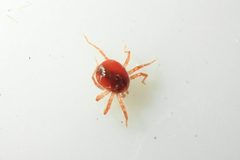
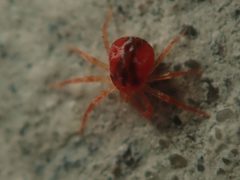
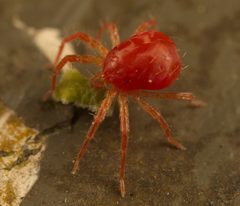
1Anystidae is a of predatory mites comprising over 100 , commonly known as whirligig mites. They are active found in soils and on vegetation worldwide. The family includes notable such as Anystis, Tarsotomus, and Chaussieria. Several species have been investigated for potential against agricultural pests including thrips, aphids, and spider mites.
Pronunciation
How to pronounce Anystidae: /ænɪˈstaɪdiː/
These audio files are automatically generated. While they are not always 100% accurate, they are a good starting point.
Identification
Anystid mites are distinguished by their active, fast-moving and long legs relative to body size. The prelarval stage is motile with , five pairs of setae, sickle-shaped tarsal claws, and a prominent Claparède's organ—features visible under magnification. possess adapted for and exhibit distinctive mouthpart cleaning behavior involving repeated insertion of the palp between the cheliceral digits. Tarsotomus are associated with warm, dry, sparsely vegetated and often lie inactive on their dorsum at room temperature.
Images
Habitat
Found in soils and on plants worldwide. Specific occupy distinct : Tarsotomus inhabit warm, dry, sparsely covered and are active on hot surfaces; Chaussieria venustissima occurs in dry habitats where the motile prelarva may seek moist refugia. Anystis agilis has been documented in California vineyards.
Distribution
distribution with records from Europe (France, Switzerland, Greece, Germany, Ukraine, Northern Ireland), Asia (Iran), Australia, and North America.
Seasonality
Two to three per year for Anystis in field conditions. Summer occurs in Anystis baccarum, either as or tritonymphs.
Diet
. Anystis baccarum has been observed preying on thrips (Thrips parvispinus), aphids (Aphis idaei), spider mites (Neotetranychus rubi), apple rust mites (), and other small arthropods.
Life Cycle
Six stages: , prelarva, larva, , deutonymph, and tritonymph, followed by males and females. Developmental time from egg to adult ranges 44–82 days at 21–22°C for three Anystis . Total lifespan of 66 days at 21°C measured for Anystis agilis. Aestivating tritonymphs of Anystis baccarum may exceed 200 days developmental time and 300 days total lifespan. The prelarva is motile for 1–5 hours, does not feed, and exhibits negative .
Behavior
exhibit mouthpart cleaning involving repeated insertion and withdrawal of the palp between the , with the palp's tarsal claw scraping the cheliceral digits. Tarsotomus produce stalked , often deposited on top of one another. Many Tarsotomus species become inactive and lie on their dorsum at room temperature but are active on hot surfaces. The motile prelarva shows negative , potentially guiding it to moist .
Ecological Role
Predatory mites that contribute to of pest . Anystis baccarum has been shown to reduce thrips populations by 80% in greenhouse trials and suppress apple rust mite populations in orchards.
Human Relevance
Investigated as agents for agricultural pests. Anystis baccarum and Anystis agilis have potential for managing thrips, aphids, spider mites, and eriophyid mites in crops including peppers, raspberries, apples, and grapes. Growers are encouraged to conserve Anystis baccarum in orchards. However, the searching , cannibalistic tendencies, and long time of A. baccarum suggest it should not be used as a sole control agent.
Sources and further reading
- BugGuide
- Wikipedia
- GBIF taxonomy match
- iNaturalist taxon
- NCBI Taxonomy
- Catalogue of Life
- Mouthpart cleaning behavior in an adult Anystid mite (Acari: Anystidae)
- Biology of the Mite, Anystis agilis (Acari: Anystidae) : a California Vineyard Predator1
- How long do whirligig mites live? A survey of lifespan in Anystidae (Acari: Trombidiformes)
- Observations on a motile prelarva in Chaussieria venustissima (Berlese, 1882) (Acari: Anystidae), with a description of the larva
- The taxonomy of Tarsotomus Berlese and Paratarsotomus Kuznetsov (Acarina : Anystidae : Erythracarinae) with observations on the natural history of Tarsotomus
- Functional response of Anystis baccarum (Acari: Anystidae) preying on two raspberry pests: Aphis idaei (Hemiptera: Aphididae) and Neotetranychus rubi (Acari: Tetranychidae)
- Investigating the potential of Anystis baccarum (Acari: Anystidae) and Orius insidiosus (Heteroptera: Anthocoridae) as biological control agents for Thrips parvispinus (Thysanoptera: Thripidae) in laboratory and greenhouse cage trials
- Impact of the predatory mite Anystis baccarum (Prostigmata: Anystidae) on apple rust mite Aculus schlechtendali (Prostigmata: Eriophyidae) populations in Northern Ireland Bramley orchards