
Peltoperlidae
Claassen, 1931
roach-like stoneflies, roachflies
Genus Guides
5- Peltoperla
- Sierraperla(giant roachfly)
- Soliperla
- Tallaperla(roach-like stoneflies)
- Yoraperla(roach-like stoneflies)
is a of stoneflies comprising 11 and approximately 46 known . Larvae are dorsoventrally flattened with expanded thoracic plates, giving them a distinctive roach-like appearance. The family exhibits semivoltine lasting one to two years, with typically occurring from April through June. Members are classified as -, playing a significant role in leaf litter decomposition in lotic systems.
Pronunciation
How to pronounce Peltoperlidae: //ˌpɛl.toʊˈpɜr.lɪˌdi//
These audio files are automatically generated. While they are not always 100% accurate, they are a good starting point.
Identification
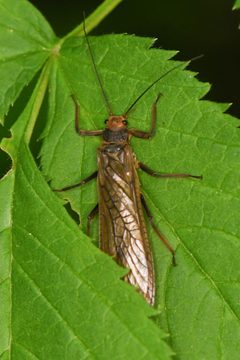
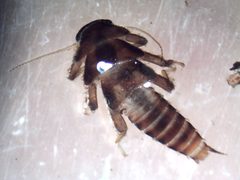
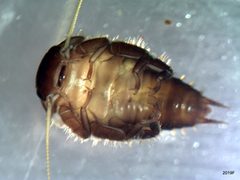
Larvae are distinguished from other Plecoptera by their dorsoventrally flattened, brown, roach-like body form with expanded thoracic plates covering the leg bases, , and . Tapering tracheal gills are present at the bases of the legs on the , but dense tufts or branching gills are absent from the thorax and abdomen. Larvae possess broad, chisel-like . are recognized by two ocelli in addition to , sclerotized rod-shaped male , and the absence of cross- in the anal lobe of the forewings.
Images
Habitat
Flowing streams (lotic systems) characterized by sediments, vascular plants, and detritus. Larvae are specifically associated with leaf litter and debris accumulations in both riffle and pool . Water chemistry, particularly base-flow alkalinity, influences distribution: some species require alkalinity >2 mg L⁻¹ CaCO₃, with dominance at sites >15 mg L⁻¹.
Distribution
Holarctic distribution including North America (California, West Virginia, Virginia, Alabama, Alberta), Asia (China including Guangxi, Russian Far East, Western Transbaikalia), and Malesia. Fossil record extends to Lower Cretaceous (Neocomian) deposits in Western Transbaikalia, Russia.
Seasonality
occurs from late spring through early summer, primarily April through June.
Diet
-: larvae chew and mine through leaf litter, contributing significantly to leaf breakdown and coarse particulate organic matter processing in streams.
Life Cycle
Semivoltine (one to two year ) with 18-month nymphal period following a 6-month . Development includes approximately 14-15 instars. Some exhibit 'leaky' cohorts with variable development periods (one, two, or three years) resulting in high among cohorts.
Behavior
Clinger-sprawler: larvae attach to surfaces in erosional or rest loosely on top of substrates. engage in (drumming) for mate-finding, with -specific call patterns including repeated monophasic signals, percussive intervals, and sequenced 3-way exchanges between males and females.
Ecological Role
Significant contributor to leaf litter breakdown in headwater streams. Sensitive bioindicator of environmental disturbance, particularly intolerant to loss of coarse particulate organic matter. Production values documented at 17-509 mg m⁻² y⁻¹ depending on watershed characteristics.
Human Relevance
Used as bioindicators of stream health due to sensitivity to degradation and water chemistry changes.
Similar Taxa
- PerlidaeBoth exhibit drumming and belong to Systellognatha; Perlidae larvae lack the expanded thoracic plates and roach-like body form of , and typically possess different gill arrangements.
- PteronarcyidaeBoth are in the superfamily Pteronarcyoidea and share lotic ; Pteronarcyidae larvae are generally larger with different body proportions and gill structures, and have different wing venation patterns.
Sources and further reading
- BugGuide
- Wikipedia
- GBIF taxonomy match
- iNaturalist taxon
- NCBI Taxonomy
- Catalogue of Life
- First instar nymphs of two peltoperlid stoneflies (Insecta, Plecoptera, Peltoperlidae)
- Stonefly drumming behavior descriptions of three Soliperla Ricker, 1952 species (Plecoptera: Peltoperlidae)
- The most ancient roachfly (Insecta: Plecoptera, Peltoperlidae) from the Lower Cretaceous of the West Transbaikalia, Russia
- A new species of Cryptoperla Needham, 1909 (Plecoptera: Peltoperlidae) from Guangxi of China, based on male, female, and larval stage
- Patterns and evolution of drumming behavior in the stonefly families Perlidae and Peltoperlidae1
- Genetic evidence for `leaky' cohorts in the semivoltine stonefly Peltoperla tarteri (Plecoptera: Peltoperlidae)
- Drumming behavior of two stonefly species,Microperla brevicaudaKawai (Peltoperlidae) andKamimuria tibialis(Pictet) (Perlidae), in relation to other behaviors
- Drumming behavior of twelve North American stonefly (Plecoptera) species: First descriptions in Peltoperlidae, Taeniopterygidae and Chloroperlidae1
- Ecological Life History of Peltoperla Tarteri (Plecoptera: Peltoperlidae) From Big Hollow of Paint Creek, Fayette County, West Virginia
- The life history and ecology ofPeltoperla maria(Plecoptera: Peltoperlidae) in a small spring-fed stream
- Ecology of Peltoperla arcuata and Tallaperla maria (Plecoptera: Peltoperlidae) at the Fernow Experimental Forest, Tucker County, West Virginia