Eucharitidae
Walker, 1846
eucharitid wasps, ant parasitoid wasps
Subfamily Guides
2is a of highly specialized in the superfamily Chalcidoidea. The family contains approximately 55 and over 400 distributed across four : Akapalinae, Eucharitinae, Gollumiellinae, and Oraseminae. Eucharitids are unique among parasitoids in their ability to exploit ants as , overcoming the sophisticated defense systems that typically protect colonies. Most species are tropical, though some extend into temperate regions.
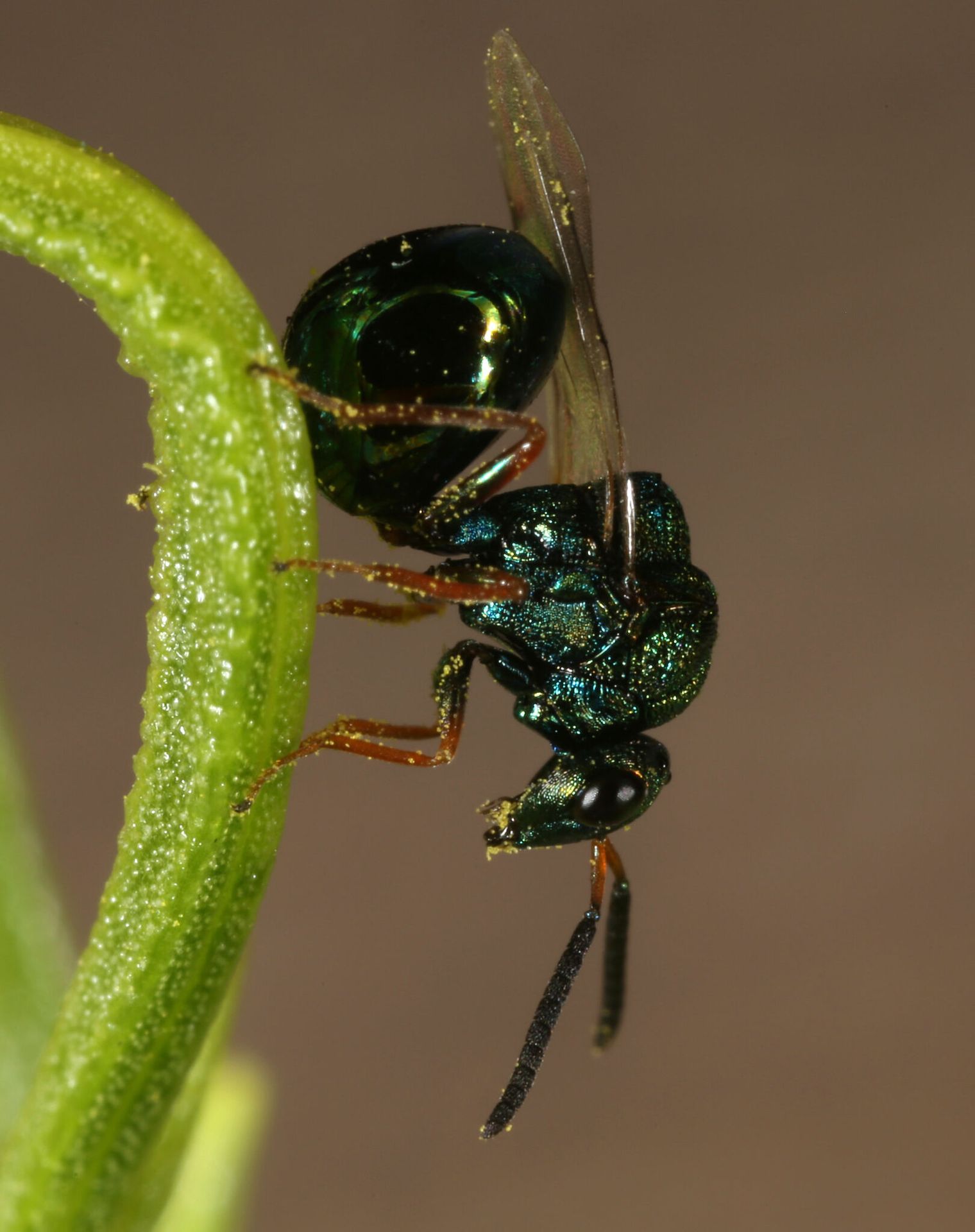
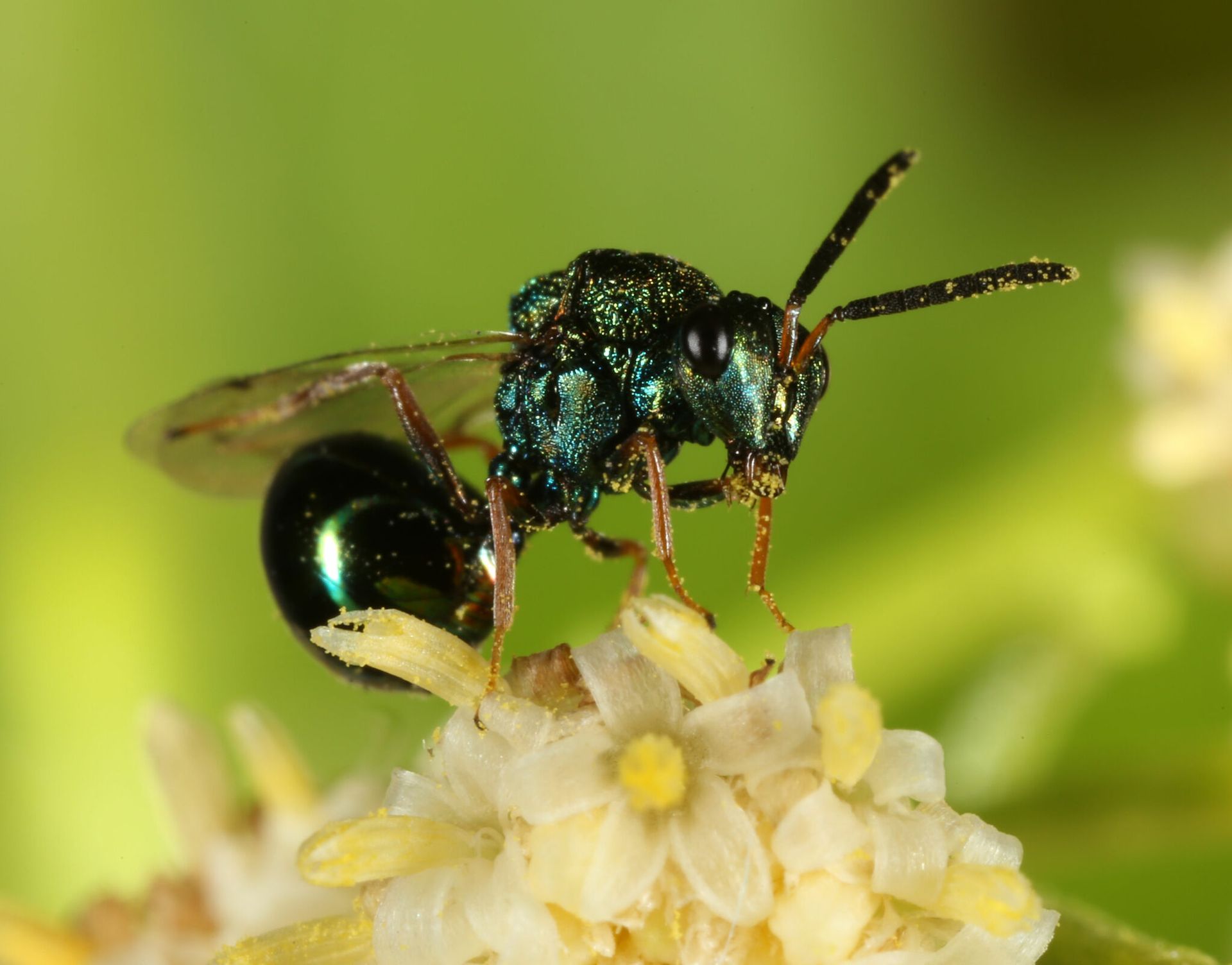
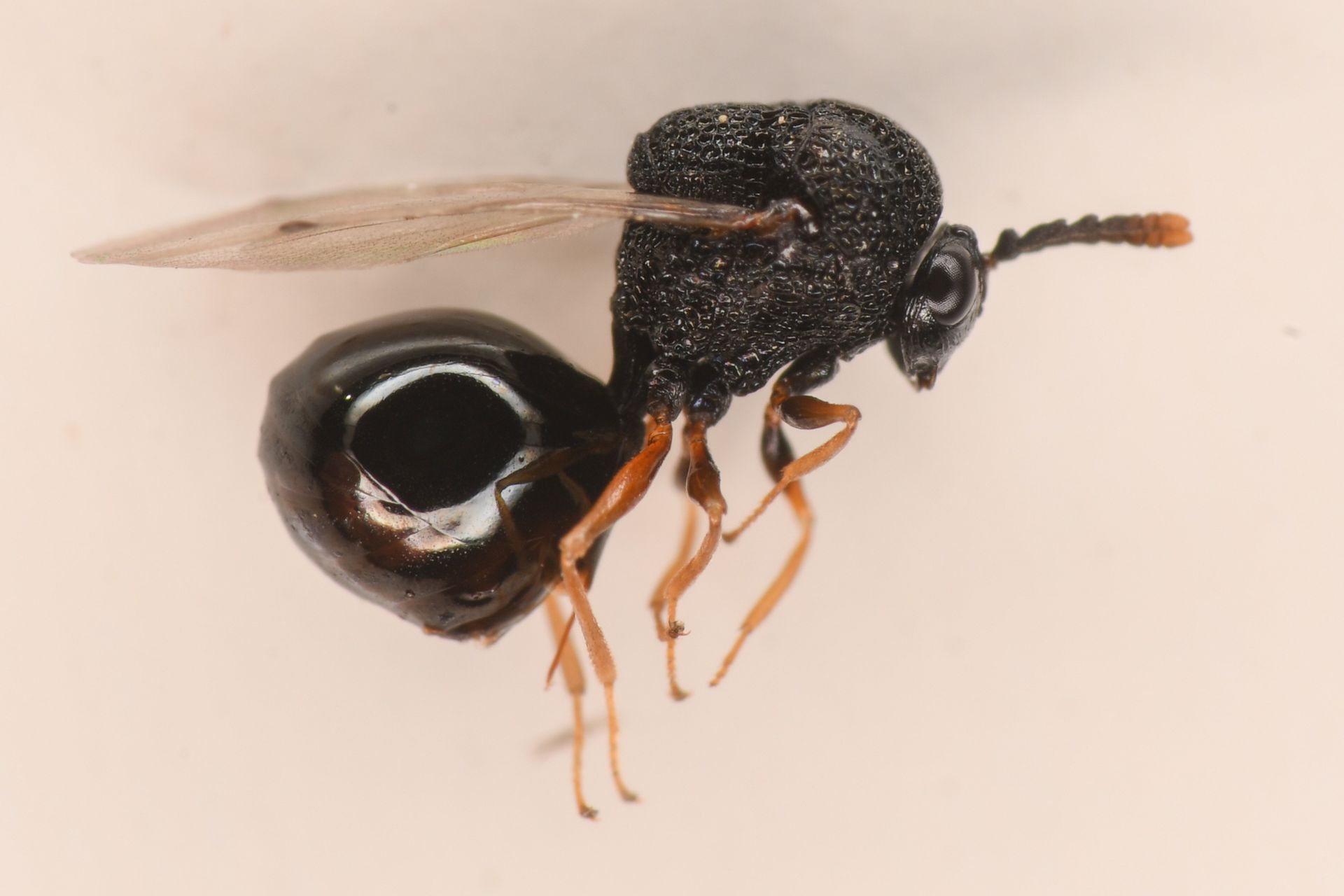
Pronunciation
How to pronounce Eucharitidae: //juːˌkæɹɪˈtaɪdiː//
These audio files are automatically generated. While they are not always 100% accurate, they are a good starting point.
Identification
can be distinguished from other Chalcidoidea by the combination of: prepectus to pronotum in the same plane; small pronotum concealed dorsally by the ; long petiole with relatively small ; and forewing venation with long marginal/stigmal but very short postmarginal veins. Within the , can be separated by oviposition : Oraseminae and some Eucharitini insert into plant tissue cavities using an enlarged ovipositor; Gollumiellinae attach eggs to plants with ropey secretions; Psilocharis and some Eucharitini place eggs among trichomes or on plant surfaces.
Images
Appearance
Small to moderately sized , ranging from 2.0 to 5.4 mm in length. Body coloration varies from metallic (often blue, green, or purple) to black. possess 13 or fewer segments in most , though some have up to 26. The pronotum is small and hidden dorsally by the . The is relatively small with a notably long petiole. Forewings display a moderately long and stigmal , with extremely short postmarginal veins. The prepectus lies in the same plane as and is to the pronotum.
Habitat
Primarily tropical and subtropical regions. are found in vegetation near colonies, where females oviposit into leaves, stems, flower buds, or fruits of various plants. Specific plants include blueberry, tea, oak, olive, mango, banana, Pseudabutilon virgatum, Urvillea chacoensis, Vassobia breviflora, and various umbellifers. The effective is defined by proximity to suitable ant host colonies rather than specific vegetation types.
Distribution
Worldwide distribution concentrated in tropical regions, with extensions into temperate zones. Documented from Central and South America ( Rica, Ecuador, Brazil, Argentina), the Caribbean, North America (southern Canada to southern United States including Texas, Florida, Massachusetts, Delaware, Colorado, Vermont, California), Africa (South Africa), Asia (China, Japan, Malaysia, Indonesia, India), and Europe (Poland, Baltic region). The Orasema ranges from northern Argentina to southern Canada. Some genera are more restricted: Gollumiellinae is Indo-Pacific; Akapalinae is and limited.
Seasonality
occurs year-round, with peak activity during hot and humid months. timing varies by and latitude: Pseudometagea schwarzii emerges in June in southern Ontario. Seasonal patterns are more strongly influenced by colony size and availability than by calendar season.
Host Associations
- Formicidae (ants) - obligate specialized of ; each typically parasitizes one ant
- Pheidole - primary for Oraseminae
- Solenopsis - fire ants and little fire ants parasitized by Oraseminae
- Camponotus - for Lophyrocera and some Eucharitinae
- Lasius - Lasius neoniger for Pseudometagea schwarzii; Lasius nipponensis and L. cf. fuliginosus for related
- Formica - probable for Eucharis adscendens in Poland
- Ponerinae - for some Eucharitinae
- Ectatommatinae - for some Eucharitinae
- Myrmicinae - broad for Oraseminae
- Formicinae - for some Eucharitinae
- Paratrechina - attracted to Gollumiellinae by specialized secretions
Life Cycle
Females deposit away from nests into plant tissue or on plant surfaces. Eggs are translucent white, elliptical, approximately 0.19 mm long, flattening on one side; they darken to brown before hatching in about 10 days. First-instar larvae are (leg-bearing, mobile larvae) approximately 0.13 mm long that remain on the plant for 6-7 days. Planidia attach to foraging ants (or occasionally to intermediate insect prey) and are transported to the ant nest. Once in the chamber, larvae attach to larvae; some are internal initially, others external, but all complete development as . Feeding is limited until host , after which most host tissue is consumed. Development from planidium to averages 29.5 days in some species, with pupal stage averaging 8.2 days. occurs (2-4 per host). Adults emerge from ant nests, typically in morning with males preceding females.
Behavior
Planidial larvae exhibit active -seeking, attaching to passing foraging ants; some can jump up to 10 mm from leaves onto ants. Gollumiellinae are suspended on erect ropey secretions that attract specific species. acquire host colony odor, enabling them to be groomed and fed by ants without aggression; workers may even assist wasp from hosts. Males typically swarm 1-2 feet above nests to await females; in some species, males wait on surrounding foliage. Mating often occurs immediately upon female emergence, sometimes before females take or while still inside the nest. Females may lay all eggs in a single day; ranges from 1000 to 10000 eggs per female.
Ecological Role
Human Relevance
Candidate agents for ants, particularly Solenopsis fire ants, offering an alternative to environmentally damaging . Some are considered minor agricultural pests: Kapala species cause leaf drying at oviposition sites and may reduce tea leaf flavor quality. Orasema species have been evaluated for fire control. First record in Poland (2011) extended known European range northward.
Similar Taxa
- Hybrizontinae (Ichneumonidae)also with specialized ; distinguished by oviposition strategy—Hybrizontinae females hover over or hang from vegetation to attack ant larvae being carried by , rather than using phoretic
- Neoneurini (Braconidae)third major group of ; differ in and location mechanisms
- other Chalcidoidea distinguished by prepectus-pronotum, long petiole, and highly specialized not found in other chalcid
More Details
Subfamily diversity
Oraseminae and Eucharitinae contain most and . Oraseminae specialize on Myrmicinae ants (especially Pheidole and Solenopsis). Eucharitinae parasitize poneromorph ants, Ponerinae, Formicinae, and Ectatommatinae. Gollumiellinae (two Indo-Pacific genera) use unique suspension mechanism. Akapalinae is (Akapala).
Chemical ecology
odor acquisition is critical for colony integration; passively obtain host odor upon entry, providing temporary protection until scent dissipates and wasps depart.
Fossil record
Palaeocharis is known from Eocene Baltic amber, indicating ancient origins of the .
Sources and further reading
- BugGuide
- Wikipedia
- GBIF taxonomy match
- iNaturalist taxon
- NCBI Taxonomy
- Catalogue of Life
- Alternative host-searching strategy in Ghilaromma orientalis
- Diversity and behavior of Eucharitidae Family (Hymenoptera: Eucharitidae) parasitoids of ants (Hymnoptera: Formicidae)
- The New World ant parasitoid genus Orasema (Hymenoptera: Eucharitidae)
- Eucharitidae (Hymenoptera: Chalcidoidea): Biology and Potential for Biological Control
- Three new species of Gollumiella Hedqvist (Hymenoptera: Eucharitidae)
- Phylogenetics of ant parasitoids in the subfamily Oraseminae (Hymenoptera: Eucharitidae)
- A new genus of Eucharitidae (Hymenoptera: Chalcidoidea), with notes on life history and immature stages
- Obeza floridana, a Parasitoid of Camponotus abdominalis floridanus from Florida (Hymenoptera: Eucharitidae, Formicidae)
- Discovery of the ant parasitoid wasp genus Saccharissa Kirby, 1886 (Hymenoptera, Eucharitidae) from Japan
- Description of the species of Dicoelothorax Ashmead (Chalcidoidea, Eucharitidae) and biology of D. platycerus Ashmead
- A new species of Pseudochalcura Ashmead (Chalcidoidea: Eucharitidae) from Argentina with descriptions of alternate sexes of two other species
- PSEUDOMETAGEA SCHWARZII (ASHM.) (EUCHARITIDAE: HYMENOPTERA), A PARASITE OF LASIUS NEONIGER EMERY (FORMICIDAE: HYMENOPTERA)
- Eucharitidae (Hymenoptera), a chalcid wasp family new to the fauna of Poland
- Distributional range expansion of the parasitic wasp Lirata batesella (Westwood, 1874) (Hymenoptera, Eucharitidae)
- Biology and description of a new species of Lophyrocera Cameron (Hymenoptera: Eucharitidae) from Argentina
- Morphology and life history of an ant parasitoid, Psilocharis afra (Hymenoptera: Eucharitidae)