
Dryomyzidae
Schiner, 1862
Genus Guides
4A small of acalyptrate flies containing approximately 22 extant in 6 . range 4–18 mm with yellow to brown or rust-yellow coloration, prominent bristles, and characteristically large wings. Larvae are saprophagous, feeding on decaying organic matter including carrion, , and fungi. One genus, Oedoparena, has evolved a specialized predatory as an intertidal mesopredator on barnacles. Adults are typically found in moist, shady among low-growing vegetation. The family is primarily distributed in the Holarctic region, with some species in the Southern Hemisphere.
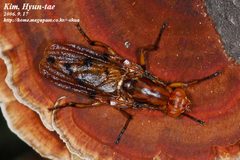
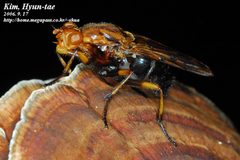
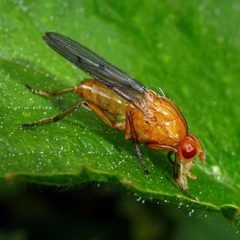
Pronunciation
How to pronounce Dryomyzidae: //ˌdraɪ.oʊˈmɪzɪˌdiː//
These audio files are automatically generated. While they are not always 100% accurate, they are a good starting point.
Identification
Distinguished from related acalyptrate by the combination of: very large wings; complete subcosta well separated from 1; prelabrum protruding from ; absence of vibrissae; and divergent postvertical bristles. Distinguished from Sciomyzidae by wing venation and bristle patterns. Oedoparena can be recognized by their association with intertidal barnacles.
Images
Appearance
Small to medium flies, 4–18 mm in length. Body yellow to brown or rust-yellow with prominent bristles. Wings very large relative to body size. with prelabrum protruding from ; vibrissae absent; postvertical bristles divergent. Wing venation with complete subcosta well separated from 1.
Habitat
occur in moist, shady among low-growing vegetation. Larval habitats vary: most feed on decaying organic matter (carrion, , fungi); Oedoparena are intertidal, associated with barnacles on rocky shores.
Distribution
Principally Holarctic, with some in the Southern Hemisphere. Documented from North America, Europe, Asia (including India, Japan), and South America (Colombia: El Tuparro).
Seasonality
Oedoparena are , with peak larval abundance in late spring and early summer. activity patterns for most species poorly documented.
Diet
Larvae feed on decaying organic matter including carrion, , and fungi. Oedoparena larvae are predatory, feeding on barnacles (Balanus glandula, Chthamalus dalli). feeding habits largely unknown.
Host Associations
- Balanus glandula - preyOedoparena larvae prey on this barnacle in intertidal zones
- Chthamalus dalli - preyOedoparena larvae prey on this barnacle in intertidal zones
Life Cycle
Most : larvae develop in decaying organic matter. Oedoparena species: , with larvae developing inside barnacle shells. Females of Dryomyza anilis arrive at carcasses to oviposit. Specific sites and stages poorly documented for most species.
Behavior
Males of Dryomyza anilis aggregate at carcasses and establish ideal despotic distributions, with highest mating success in central zones due to female arrival patterns. Male-male fights and kleptoparasitic take-overs of mating pairs are common; large males guard ovipositing females while small males frequently suffer take-overs despite initiating 38% of matings. Oedoparena larvae exhibit thermal up to 37°C but are limited to cooler microhabitats in high intertidal zones.
Ecological Role
Saprophagous larvae contribute to decomposition of carrion, , and fungal matter. Oedoparena function as intertidal mesopredators, with potential to structure high intertidal through barnacle ; increased larval densities can raise barnacle mortality from 5% to nearly 30% (Balanus glandula) and from <20% to >60% (Chthamalus dalli).
Human Relevance
Of forensic interest due to larval association with carrion; presence on carcasses can indicate postmortem interval. Dryomyza flaveola and other have been studied for sex-related visitation patterns to pig carcasses. Pitfall traps are more effective than sweep nets for sampling Dryomyzidae at carcass sites.
Similar Taxa
- SciomyzidaeSimilar acalyptrate flies with large wings; distinguished by wing venation (subcosta structure) and bristle patterns
- SepsidaeSimilar small flies associated with and decaying matter; distinguished by wing venation and body bristle patterns
More Details
Fossil record
Four fossil in three known from the Tertiary: Dryomyza pelidua, D. shanwangensis, Palaeotimia ihoesti, and Prodryomyza electrica.
Taxonomic composition
Six extant : Dryomyza (12 ), Dryope (3 species), Oedoparena (3 species), Paradryomyza (4 species), Pseudoneuroctena (1 species), Steyskalomyza (1 species). Two additional genera known only as fossils: Palaeotimia and Prodryomyza.
Thermal ecology of Oedoparena
Laboratory studies show O. glauca larvae tolerate temperatures up to 37°C, but field experiments demonstrate that shading to reduce thermal stress greatly increases larval abundance and rates, indicating microhabitat temperature is a critical limiting factor.
Sources and further reading
- BugGuide
- Wikipedia
- GBIF taxonomy match
- iNaturalist taxon
- NCBI Taxonomy
- Catalogue of Life
- A note on Indian Dryomyzidae (Insecta: Diptera) with special reference to the distribution pattern
- Male distribution and interactions at female oviposition sites as factors affecting mating success in the flyDryomyza anilis (Dryomyzidae)
- The natural history, thermal physiology, and ecological impacts of intertidal mesopredators, Oedoparena spp. (Diptera: Dryomyzidae)
- The effect of postcopulatory male behaviour on ejaculate distribution within the female sperm storage organs of the fly, Dryomyza anilis (Diptera : Dryomyzidae)
- Diptera (Dryomyzidae, Fanniidae, Muscidae, Piophilidae) Associated With Pig Carcasses in a Forest Habitat of Poland: Sex-Related Patterns of Visitation and Effectiveness of Sampling Methods
- New range records and life history observations of insects (Diptera: Dryomyzidae, Chironomidae; Coleoptera: Staphylinidae) associated with barnacles (Balanomorpha: Balanidae, Chthamalidae) on the Pacific coasts of North America and Japan