
Dryomyza anilis
Fallén, 1820
Hooded Dryomyza
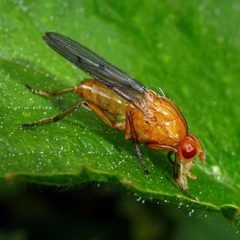
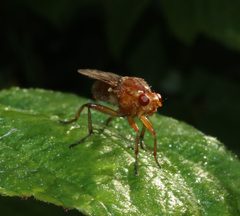
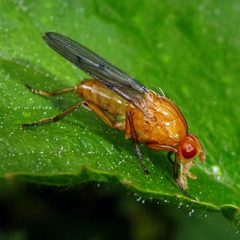
Dryomyza anilis is a medium-sized fly, 7–14 mm in length, and the type of Dryomyza. It is distinguished by light-brown and orange coloration with large red . The species exhibits complex reproductive including male territoriality, repeated copulation-oviposition cycles, and distinctive postcopulatory tapping rituals. Laboratory-reared individuals live 28–178 days. It is the most common and strongly wing-marked species of Dryomyza in the eastern United States.
Pronunciation
How to pronounce Dryomyza anilis: //draɪˈɒmɪzə əˈnɪlɪs//
These audio files are automatically generated. While they are not always 100% accurate, they are a good starting point.
Identification
Distinguished from other Dryomyzidae by the combination of: nearly-bare , covered lunule, and developed prostigmatic and prescutellar bristles. Among eastern North American Dryomyza , it is the most common and has the strongest wing markings. D. simplex and Dryope decipita are less common sympatric species with weaker wing patterns.
Images
Habitat
Moist, shady among low-growing vegetation. frequent carrion (fox, pheasant), human excrement, and malodorous stinkhorn fungi. Development requires dead animal matter; unable to complete development on decaying plant matter or cow manure.
Distribution
Holarctic distribution. Nearctic: Canada and northern United States. Palearctic: widespread from United Kingdom to Japan. In the United Kingdom, common and widespread in England and Wales, less common in Scotland. Also recorded from Belgium and Denmark.
Seasonality
most prevalent in the wild from May to September.
Diet
feed on carrion, fungi, and excrement. Larvae derive nutrition from microorganisms in rotting organic substrates; pharyngeal ridges in larval skeletons filter food. Can develop on dead insects, vertebrates, and rotting fungi but not on decaying plant matter.
Life Cycle
: creamy white, 1.25 × 0.45 mm, with paired flanges and hexagonal surface pattern; incubation ~24 hours. Larva: three instars; first instar 1.67–2.96 mm, third instar 4.10–9.42 mm; translucent . Pupa: 4.41–6.23 mm, light yellow-brown to reddish brown with darker segments 2–4 and 12. Development from egg to pupa possible on dead animal matter but not decaying vegetation.
Behavior
Males exhibit territorial , defending carcasses and females. Larger males win resource conflicts and hold territories. Mating occurs through repeated copulation-oviposition cycles (up to six). Males remain mounted during cycles, performing postcopulatory tapping rituals (8–31 sequences of ~20 taps each) that increase success. Males provide (regurgitated drops) during courtship. Females are polyandrous, mating with multiple males; they use behavioral defenses (abdominal turning, kicking, shaking, rolling) to reject unwanted males.
Ecological Role
Saprophage, contributing to decomposition of carrion and organic matter. Documented use of Pacific salmon carcasses as food source and oviposition substrate in coastal North Pacific; potential sensitivity to salmon declines.
Human Relevance
Used extensively in behavioral research on , sperm competition, and mating systems. sequenced as part of the Darwin Tree of Life project.
Similar Taxa
- Dryomyza simplexLess common sympatric in eastern United States with weaker wing markings
- Dryope decipitaLess common sympatric in eastern United States with weaker wing markings
More Details
Taxonomic history
Recently returned to Dryomyza from Neuroctena; type of Dryomyza. Dryomyzidae formerly treated as part of Sciomyzidae, now recognized as separate family with two .
Sperm competition mechanism
Last male achieved through postcopulatory tapping, which moves sperm into the singlet spermatheca used preferentially during -laying. Males removed before tapping show drastically reduced success.
Sources and further reading
- BugGuide
- Wikipedia
- GBIF taxonomy match
- iNaturalist taxon
- NCBI Taxonomy
- Catalogue of Life
- Bembicid Holdings | Entomology Research Museum
- Mating behavior and sperm competition in the fly, Dryomyza anilis
- Female Mating Behaviour and Multiple Matings in the Fly, Dryomyza Anilis
- Size-related male movement and its effect on spatial and temporal male distribution at female oviposition sites in the fly Dryomyza anilis
- The effect of postcopulatory male behaviour on ejaculate distribution within the female sperm storage organs of the fly, Dryomyza anilis (Diptera : Dryomyzidae)
- Male distribution and interactions at female oviposition sites as factors affecting mating success in the flyDryomyza anilis (Dryomyzidae)
- The genome sequence of the acalyptrate fly Dryomyza anilis Fallén, 1820.