
Ciidae
Leach, 1819
Minute Tree-Fungus Beetles, Shelf Fungus Beetles
Subfamily Guides
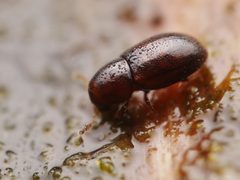
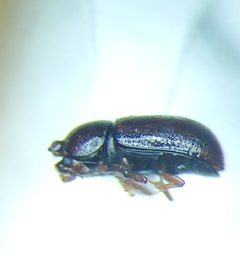
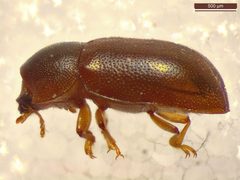
1, commonly known as or shelf , are a of small beetles within the superfamily Tenebrionoidea. and larvae inhabit fruiting bodies of bracket fungi (Polyporales), particularly Polyporaceae and Corticiaceae, where they burrow inside the fungal tissue. The family is most diverse in warmer regions but has a distribution extending to northern latitudes including Scandinavia. Development from to adult can occur in as little as two months, and some are parthenogenetic. A few species, notably Cis chinensis, are recognized as pests of commercially dried fungi.
Pronunciation
How to pronounce Ciidae: /ˈkiː.aɪ.iː/
These audio files are automatically generated. While they are not always 100% accurate, they are a good starting point.
Images
Habitat
Fruiting bodies of bracket fungi (Polyporales), primarily Polyporaceae and Corticiaceae; coarse woody debris. Beetles inhabit old specimens or old tissue of the fungi, with larvae and burrowing inside the fungal substrate.
Distribution
distribution with highest diversity in warmer regions; extends polewards to Scandinavia and other northern areas. Present on all major continents including North America, South America, Europe, Asia, Africa, and Australia.
Diet
Fungal tissue of bracket fungi (Polyporales); specifically the fruiting bodies of Polyporaceae and Corticiaceae.
Host Associations
- Polyporaceae - and food sourcePrimary of bracket fungi
- Corticiaceae - and food sourceSecondary of bracket fungi
- Stereaceae - Documented for some
- Antrodia xantha - Specific fungus for Cis chinensis in Switzerland
- Ganoderma lucidum - for pest Cis chinensis in commercial settings
Life Cycle
Complete with , larval, pupal, and stages. Development from egg to adult has been observed to take as little as two months in some . Larval development includes 4-5 larval stages. Some species are parthenogenetic.
Behavior
and larvae burrow inside fungal fruiting bodies. Adults have been observed flying to and from fungal substrates. Some show sexual involving abdominal fovea in males for secretion. Heavy by phoretic mites (Histiostomatidae) have been documented on some .
Ecological Role
Primary consumers of fungal tissue in bracket fungi . Serve as prey for predatory insects including rove beetles (Staphylinidae), checkered beetles (Cleridae), and larvae. Act as for phoretic mites and endoparasitoid wasps in the Mymaridae.
Human Relevance
Some are minor pests of commercial dried mushrooms and fungi, particularly Cis chinensis which infests dried fruiting bodies of Ganoderma lucidum. Otherwise of minimal direct economic importance.
Similar Taxa
- ErotylidaeAlso known as pleasing fungus beetles; share on fungi but generally larger with different body proportions and antennal structure
- EndomychidaeHandsome fungus beetles; overlap in fungal but differ in body shape and antennal club structure
- MycetophagidaeHairy fungus beetles; similar size range and but distinguished by hairy body covering and different antennal formula
- TetratomidaePolypore fungus beetles; share polypore but differ in body form and tarsal structure
Sources and further reading
- BugGuide
- Wikipedia
- GBIF taxonomy match
- iNaturalist taxon
- NCBI Taxonomy
- Catalogue of Life
- Publications | Entomology Research Museum
- Bug Eric: Fungus Party-y-y!
- Bug Eric: 2022
- The Australian Paratrichapus Scott (Coleoptera: Ciidae)
- A New Species of Cis Latreille (Coleoptera: Ciidae) from the USA, with Comments on the Use by Ciidae of Stereaceae Fungi (Basidiomycota: Agaricomycetes: Russulales) As Hosts
- An essay on the tribe Xylographellini (Coleoptera: Tenebrionoidea: Ciidae)
- Cis regius, a new species of Cis Latreille (Coleoptera: Ciidae) from Southern Africa
- Der Fremdling im Therapiegarten – Cis chinensis (Coleoptera, Ciidae) und sein Umfeld
- Redescription of Cis taurus (Reitter, 1878) (Coleoptera: Ciidae)
- A new species of genus Euxestocis Miyatake, 1954 (Coleoptera, Ciidae) from Yunnan Province, China
- The Fruiting-Bodies of Macrofungi as Habitats for Beetles of the Family Ciidae (Coleoptera)
- Ceracis luci sp. nov., the first Ciidae species (Coleoptera: Tenebrionoidea) from the Caatinga biome
- The first record of the genus Dichodontocis Kawanabe, 1994 (Coleoptera, Ciidae) from China, with the description of a new species and its larva.