
Pauropodidae
Lubbock, 1867
Genus Guides
3Pauropodidae is the most diverse of pauropods, containing 27 and over 800 . Members are minute, soil-dwelling myriapods typically less than 2 mm in length. The family exhibits subcosmopolitan distribution and includes the only known fossil pauropod, Eopauropus balticus, preserved in Baltic amber. This fossil is notable given that living pauropods are strictly soil-dwelling and rarely exposed to surface conditions where resin trapping occurs.
Pronunciation
How to pronounce Pauropodidae: //ˌpaʊroʊˈpɒdɪdi//
These audio files are automatically generated. While they are not always 100% accurate, they are a good starting point.
Identification
Distinguished from Eurypauropodidae by entire (undivided) tergites and soft, weakly sclerotized body that can curve in all directions; Eurypauropodidae have divided tergites and rigid bodies. Antennal branch with one seta and one globulus (vs. two setae and one globulus in some related groups). Single anal plate on pygidial sternum. Leg segmentation pattern and number diagnostic at generic level: most Pauropodidae have nine leg pairs with six segments on middle legs, but exceptions include Cauvetauropus (eight pairs) and female Decapauropus (nine or ten pairs).
Images
Appearance
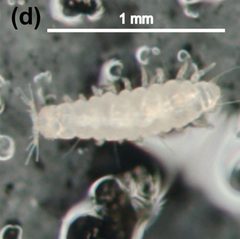
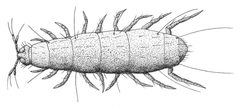
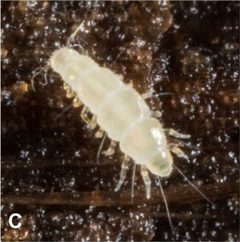
Small, whitish myriapods less than 2 mm in length. Body soft and weakly sclerotized, allowing curvature in all directions. Tergites entire (undivided) with setae arranged in regular transverse rows. bears single seta and four transverse rows of setae on surface. with branch containing one seta and one globulus (spheroid sense organ). Setae on head and tergites tapering or cylindrical. Pygidial sternum with single anal plate at middle of end. Leg number variable: most have nine pairs, but Cauvetauropus has eight pairs and female Decapauropus has nine or ten pairs. First and last leg pairs have five segments; remaining legs typically six-segmented, though some have five segments on all legs.
Habitat
Strictly soil-dwelling, inhabiting mineral soil and organic layers. Recorded from mountains and hills. Collections from the Crozet Islands were obtained from moss and soil . Avoids surface exposure, which explains rarity in amber deposits despite the 's ancient lineage.
Distribution
Subcosmopolitan distribution: found worldwide except Antarctica. Widespread include Allopauropus, Decapauropus, and Pauropus, each with subcosmopolitan ranges. Recorded from North America (United States: Georgia, Virginia, West Virginia, Washington, Oregon, North Carolina, Ohio, Massachusetts, New York), Europe (Canary Islands, Scandinavia), subantarctic islands (Crozet Islands, Kerguelen Islands), South America, Australia, New Zealand, and Asia (China).
Behavior
Strictly confined to soil; avoids surface exposure. Soft body allows movement through soil by curving in all directions. The discovery of Eopauropus balticus in Baltic amber is exceptional given this subterranean habit.
Human Relevance
Subject of taxonomic research; includes only known fossil pauropod (Eopauropus balticus) of significance for understanding pauropod evolutionary history. No known economic importance.
Similar Taxa
- EurypauropodidaeDistinguished by divided (segmented) tetrergites and rigid, heavily sclerotized bodies that cannot curve; Pauropodidae have entire tergites and soft, flexible bodies
More Details
Fossil record
Contains the only known fossil pauropod, Eopauropus balticus, from middle Eocene Baltic amber. This discovery is unexpected given the strictly soil-dwelling habits of the .
Generic diversity
27 recognized, including Allopauropus, Decapauropus, Pauropus, Stylopauropus, Cauvetauropus, and others. Three genera (Allopauropus, Decapauropus, Pauropus) are especially widespread.
Leg number variation
Most have nine leg pairs, but Cauvetauropus has eight pairs and female Decapauropus has nine or ten pairs. This variation is unique among adult pauropods and diagnostic at generic level.
Sources and further reading
- BugGuide
- Wikipedia
- GBIF taxonomy match
- iNaturalist taxon
- NCBI Taxonomy
- Catalogue of Life
- Pauropodidae (Myriapoda, Pauropoda) from the Canary Islands
- Two Pauropodidae Species (Myriapoda, Pauropoda) from the Subantarctic Crozet Islands
- Taxonomic and distributional notes on pauropods from the United States (Myriapoda, Pauropoda: Pauropodidae, Eurypauropodidae)
- Two new species of the genus Samarangopus and the first record of Eurypauropusjaponicus (Arthropoda, Myriapoda, Pauropoda, Eurypauropodidae) from China.