
Eurypauropodidae
Ryder, 1879
Genus Guides
1Eurypauropodidae is a of pauropods in the order Tetramerocerata, established by John A. Ryder in 1879. The family comprises more than 70 across four : Acopauropus, Eurypauropus, Samarangopus, and Trachypauropus. Members are distinguished from other pauropods by their relatively large size, heavily sclerotized tergites, and preference for litter over deep soil. They exhibit a broad geographic distribution across multiple continents, with the genus Samarangopus showing the widest range.
Pronunciation
How to pronounce Eurypauropodidae: /ˌjʊrɪpaʊroʊˈpɒdɪdiː/
These audio files are automatically generated. While they are not always 100% accurate, they are a good starting point.
Identification
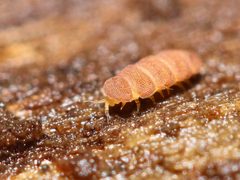
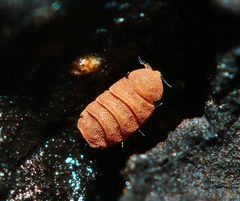
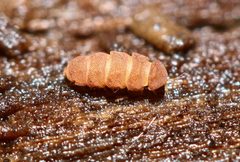
Distinguished from other pauropod by: (1) heavily sclerotized, ornamented tergites versus weakly sclerotized tergites in most pauropods; (2) six entire tergites covering and versus divided or different arrangements; (3) brown coloration versus nearly white adults in other families; (4) larger body size and robust, flattened oval shape; (5) litter-dwelling preference versus deep soil preference; (6) inability to coil body; (7) single anal plate on pygidial sternum. -level identification requires examination of tergite ornamentation patterns and leg segmentation.
Images
Habitat
Primarily inhabits leaf litter and upper soil layers rather than deep soil. Found in mixed forests and broad-leaved forests. The thick, heavily sclerotized provides resistance to drought conditions, allowing occupation of drier microhabitats than most pauropods, which require humid environments.
Distribution
Present on all continents except South America and Antarctica. Samarangopus has broadest distribution: Indomalayan realm (Nepal, Thailand, Vietnam, Philippines, Indonesia, Borneo), Afrotropical realm (Rwanda, Madagascar, Mauritius, Réunion), Australasian realm (Australia, Papua New Guinea, New Zealand, New Caledonia), and eastern Palearctic (Japan). Other genera restricted to Holarctic: Eurypauropus (Nearctic: United States; Palearctic: Japan), Trachypauropus (Palearctic: Great Britain, Spain, France, Italy, Switzerland, Austria, Hungary, Romania, Balkans, Turkey, Israel), Acopauropus (Palearctic: Algeria, Spain, France, Germany, Switzerland, Austria, Czech Republic, Poland, Romania, Balkans, Georgia, Korea).
Life Cycle
Development involves leg pair addition: juveniles observed with 5, 6, or 8 pairs of legs; possess 9 pairs of legs.
Behavior
Capable of strikingly fast movement. Unlike most pauropods, does not coil its body.
Ecological Role
Inhabits decomposing leaf litter; likely contributes to decomposition processes and nutrient cycling in forest floor .
Human Relevance
No direct economic or medical significance. Subject of taxonomic and systematic research; new continue to be described.
Similar Taxa
- PauropodidaeOther major pauropod ; distinguished by weakly sclerotized tergites, smaller size, nearly white coloration even in , preference for deep soil , and sensitivity to dry conditions.
More Details
Taxonomic history
established by John A. Ryder in 1879 based on Eurypauropus spinosus, which he found sufficiently distinct from all known pauropods to warrant separate family status. Original description based on specimens from decaying wood in Philadelphia's Fairmount Park.
Species diversity
contains over 70 : Samarangopus (38 species), Trachypauropus (12 species), Eurypauropus (11 species), Acopauropus (11 species).
Sources and further reading
- BugGuide
- Wikipedia
- GBIF taxonomy match
- iNaturalist taxon
- NCBI Taxonomy
- Catalogue of Life
- Taxonomic and distributional notes on pauropods from the United States (Myriapoda, Pauropoda: Pauropodidae, Eurypauropodidae)
- Two new species of the genus Samarangopus and the first record of Eurypauropusjaponicus (Arthropoda, Myriapoda, Pauropoda, Eurypauropodidae) from China.